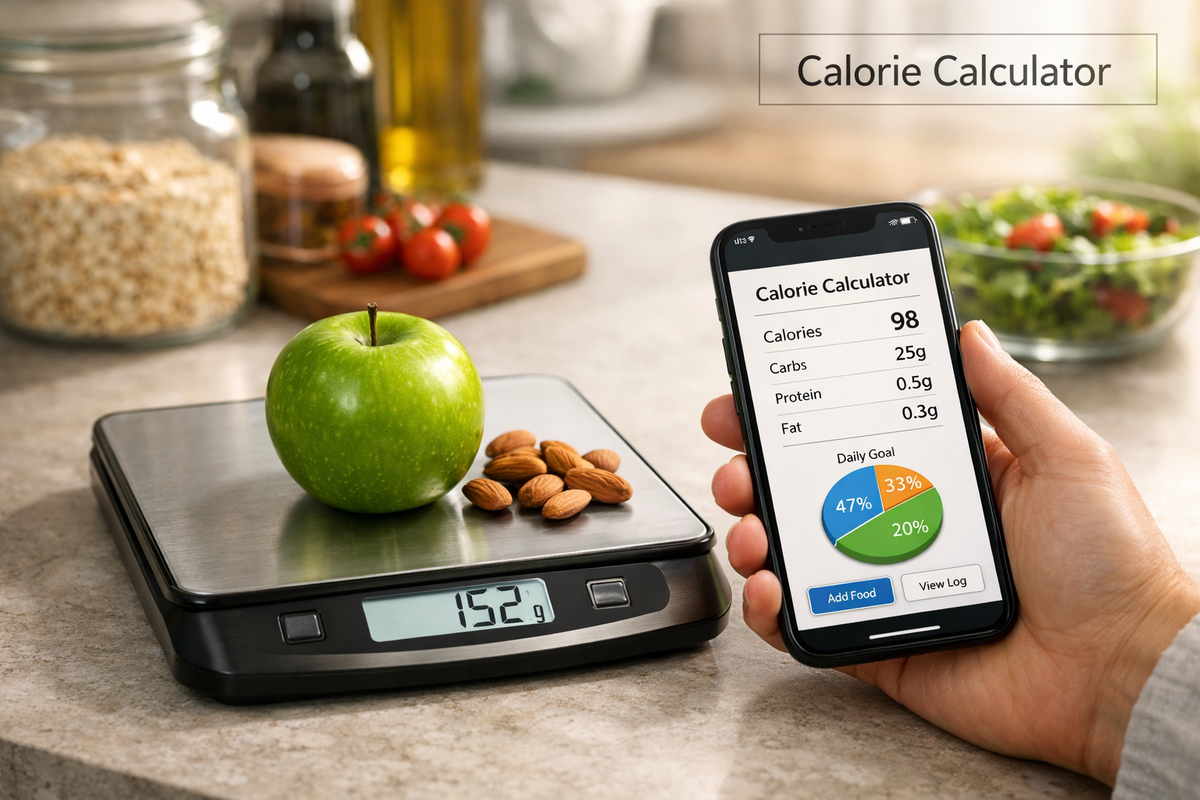
Daily Calorie Needs Calculator
How to Understand Your Results (Complete User Guide)
After calculating your calories, you will see 4 numbers. Here’s what each one means and how to use it:
BMR (Basal Metabolic Rate)
This is the number of calories your body requires to stay alive. Even if you lie in bed all day and do nothing, your body still requires this many calories for:
Important Note: You should not regularly eat below your BMR. Eating too little can slow your metabolism and make you feel weak.
Maintenance Calories
This is your most important number. If you eat this many calories daily, your weight will stay the same.
Think of this as your “balance point.”
- Eat equal to Maintenance → Weight stays stable
- Eat less than Maintenance → Weight loss
- Eat more than Maintenance → Weight gain
Weight Loss Calories
This number shows how many calories you should eat to lose weight safely. Typically, it is about 400–500 calories below maintenance. If you eat this amount daily, you may lose around 0.5 kg per week (a healthy rate). Do not reduce calories too much.
Extreme dieting can cause:
- Hair fall
- Weakness
- Hormonal problems
- Slow metabolism
Slow and steady weight loss is better.
Don’t Miss This: Are you trying to shed those extra pounds? Check out our complete guide on Effective Weight Loss Strategies for a Healthier You to start your journey today!
Weight Gain Calories
This number shows how many calories you need to gain weight. It is typically 400–500 calories above maintenance. If you eat this much daily, you may gain weight gradually in a healthy way.
Focus on:
- Protein
- Healthy fats
- Nutritious foods
- Not junk food.
Recommended for You: If you are looking for healthy ways to bulk up, don’t miss our expert guide on Healthy Weight Gain Strategies to achieve your fitness goals safely!
How to Decide What Number to Follow
If your goal is weight loss:
- Reduce 300–500 calories from your daily intake
- Walk 8,000–10,000 steps daily
- Increase protein (eggs, chicken, lentils)
- Avoid sugary drinks and junk food
If your goal is maintenance:
- Stay close to your maintenance calories
- Keep your activity level consistent
- Avoid overeating on weekends
If your goal is weight gain:
- Add 300–500 extra calories daily
- Eat protein-rich foods
- Do strength training 3–5 times a week
- Don’t skip meals
Heart Health Tip: Calculating your calories is just the start. If you’re planning to increase your workout intensity, read our guide on the Cardiac Stress Test to ensure your heart is ready for the challenge!
The Science: How Calorie Calculation Actually Works

Now that you know your numbers, let’s quickly understand what’s happening behind the scenes.
What Exactly is a Calorie Calculator?
A calorie calculator is a simple tool that estimates how many calories your body needs every day. Instead of guessing, it provides a clear starting point based on your physiology and lifestyle.
For example, two people with the same weight may still need different amounts of calories, because their activity levels or metabolism are different. That’s why this tool is useful.
Think of it like a daily guide. It doesn’t control your diet—it just helps you make better decisions.
Who Invented the Concept of Calories?
The idea of calories didn’t start with diet plans or weight loss programs. It actually began in science labs. In the early 1800s, a French scientist named Nicolas Clément introduced the term “calorie” to measure heat energy.
Later, an American scientist named Wilbur Olin Atwater changed everything. He started studying how food gives energy to the human body. To do this, he used a machine called a bomb calorimeter, which basically burned food to measure how much energy it released.
From his research, we got the basic calorie values we still use today:
- Carbohydrates = 4 calories per gram
- Protein = 4 calories per gram
- Fat = 9 calories per gram
So the numbers you see on food labels today? They come from experiments done more than 100 years ago. That’s pretty amazing when you think about it.
The Evolution of Calorie Counting: From Math to Machines
Understanding your body used to involve complex manual math. Over the last century, science has made calorie tracking much simpler and more accurate:
1919 – The Harris-Benedict Equation
One of the first famous formulas used to estimate the body’s energy needs at rest. While groundbreaking, it was based on data from a different era.
While modern calculators have evolved, this original formula set the standard for exercise science. It calculates your BMR (Basal Metabolic Rate) like this:
For Men: BMR = 66.47 + (13.75 x weight in kg) + (5.003 x height in cm) – (6.755 x age in years)
For Women: BMR = 655.1 + (9.563 x weight in kg) + (1.850 x height in cm) – (4.676 x age in years)
Note: Because people’s lifestyles and body compositions have changed since 1919, most modern tools (including ours) now use the updated Mifflin-St Jeor Equation for better accuracy.
1990 – The Mifflin-St Jeor Equation
As lifestyles became more sedentary, researchers introduced this updated formula. It is widely considered the most accurate for modern metabolic rates, which is why our calculator uses it today.
For Men: BMR = (10 x weight in kg) + (6.25 x height in cm) – (5 x age in years) + 5
For Women: BMR = (10 x weight in kg) + (6.25 x height in cm) – (5 x age in years) – 161
Today – Smart Automation
You no longer need to be a mathematician to track your health. While history gave us the formulas, modern technology has given us the speed:
- Zero Manual Math: Our tool handles the complex Mifflin-St Jeor calculations for you instantly.
- Instant Personalization: By simply entering your height, weight, and age, you get reliable data in under two seconds.
- A Clear Starting Point: No more guessing—get an accurate scientific foundation to kickstart your fitness journey today.
Types of Calorie Calculators: Which One Do You Need?
Not all calculators are created equal. Most tools you find online fall into these three categories:
- BMR (Basal Metabolic Rate) Calculators: These focus only on the energy your body needs at rest. They don’t account for your daily movement or exercise.
- TDEE (Total Daily Energy Expenditure) Calculators: These are the “gold standard.” They take your BMR and add your activity level to show exactly how much fuel you burn in a real day.
- Goal-Based Calculators: These take your TDEE and automatically add or subtract calories to help you reach a specific weight goal safely.
The Verdict: In real life, TDEE is the most useful number. While BMR is interesting, TDEE is the number you actually need to build your meal plan and see results.
How this Calculator Works
Our tool doesn’t just guess your numbers; it uses a scientific, two-step process to provide you with the most accurate results:
- Step 1: Calculating Your BMR (Basal Metabolic Rate): First, we determine the baseline calories your body needs just to stay alive (at rest). Think of this as your “idling” energy.
- Step 2: Calculating Your TDEE (Total Daily Energy Expenditure): Next, we take your BMR and add your Activity Level. This tells us exactly how much energy you burn in a real, active day.
What Are Calories?
Calories are just units of energy.
Every food you eat gives your body energy. This energy is used for:
- Moving
- Thinking
- Breathing
- Even sleeping
Example: Eating 500 calories of junk food may leave you tired, while 500 calories of healthy food keeps you full and active.
So yes, calories matter—but quality matters too.
Factors That Shape Your Personal Calorie Needs
Your calorie requirement is unique. It’s not just a random number—it’s based on these five pillars:
- Age: Younger bodies often have higher metabolic rates due to growth. As we age, metabolism slightly slows down, requiring fewer calories to maintain weight.
- Gender: Men typically have more muscle mass than women. Since muscle is metabolically “active,” it burns more energy even at rest.
- Activity Level: The more you move, the more you burn. A construction worker has vastly different needs than someone with a desk job.
- Body Composition: This is the ratio of muscle to fat. People with higher muscle percentages burn more calories throughout the day.
- Metabolism: Some people are naturally “fast burners,” while others process energy more slowly due to genetics or hormones.
Gut Health Tip: Low-calorie diets can sometimes lead to slower digestion and bloating. If you’re experiencing discomfort, check out our guide on How to Manage Constipation During Weight Loss to keep your digestive system on track.
Common Pitfalls: Why People Don’t See Results
Even with a calculator, small mistakes can stall your progress:
- Overestimating Activity: Many people select “Highly Active” when they only work out twice a week. This leads to eating more than the body actually needs.
- The “Hidden” Calories: That splash of milk in your coffee, a handful of nuts, or a sugary soda can add 300–400 uncounted calories to your day.
- Eyeballing Portions: Estimating “one cup” of rice by eye is often inaccurate. Small errors in portion sizes can lead to hundreds of extra calories over a week.
Pro-Tips for Effective Calorie Tracking
To make your journey stress-free and successful, follow these simple rules:
- Log Your Meals Daily: Consistency is better than perfection. Use an app to stay aware of your intake.
- Use a Food Scale: Measuring your food (especially oils and grains) gives you 100% accuracy.
- Prioritize Whole Foods: Natural foods like fruits, vegetables, and lean proteins keep you fuller for longer.
- Plan Ahead: Deciding what to eat before you get hungry prevents impulsive, high-calorie choices.
- Adjust as You Go: Your body changes! If you aren’t seeing results after 3-4 weeks, slightly adjust your calorie target.
Calculate Your BMI: Ready to see where you stand? Use our free BMI Calculator to find your weight category in seconds!
The Pros and Cons of Using a Calculator
The Benefits:
- Stops the Guesswork: You finally understand exactly what your body needs.
- Total Flexibility: You can still enjoy your favorite foods as long as they fit your daily “budget.”
- Sustainable Control: No more extreme dieting or skipping meals.
The Limitations:
Doesn’t Account for Hormones: Factors like stress, sleep, and hormones can also affect your weight.
It’s an Estimate: No tool is 100% perfect; it provides a scientific starting point, not an absolute rule.
Disclaimer: This calculator provides estimated values only. For medical conditions or major diet changes, consult a healthcare professional.
Calorie Burn & Weight Loss FAQs
Join Our Mission! We are actively seeking passionate contributors to share their insights on Stress Management, Mental Well-being, and Holistic Health.
Click here to Write For Us and reach a global audience today!