
What Is a Brain Sheet in Nursing?
A brain sheet is a written nursing tool that organizes key patient details for quick review during a shift.
Knowing what a brain sheet in nursing is can help you understand how this simple tool fits into a busy shift. Nurses can use it to track time-sensitive tasks, manage responsibilities, and note important changes in a patient’s condition throughout the shift.
A brain sheet can include different information depending on the clinical setting and the nurse’s responsibilities. Common entries include patient identifiers, diagnoses, allergies, vital signs, medications, laboratory results, assessment findings, tests or procedures, pending tasks, and safety concerns.
What Does a Nursing Brain Sheet Look Like?
A nursing brain sheet usually has a simple layout with sections for each patient and the information a nurse needs during the shift. Some sheets use columns, while others use boxes, checklists, or a combination of these formats.
Every nurse uses no single format. The layout depends on the clinical setting, patient needs, shift responsibilities, and the nurse’s workflow. A med-surg nurse may use a different layout from an ICU nurse, while nursing students may use a template provided by their school or clinical instructor.
A basic brain sheet may include sections for:
- Patient information: Name or identifier, room number, age, and diagnosis
- Clinical details: Allergies, vital signs, assessment findings, and changes in condition
- Medications and treatments: Scheduled medications, treatments, and procedures
- Labs and tests: Recent results, abnormal findings, and pending tests
- Tasks: Care activities, follow-ups, and items that still need attention
- Safety and priorities: Fall risk, precautions, lines or devices, and other important concerns
The information may stay similar across different brain sheets, but how nurses arrange it differs. Some prefer a table with several patient columns, while others use separate sections or checklists. The best format keeps relevant information easy to find and fits the nurse’s clinical workflow.
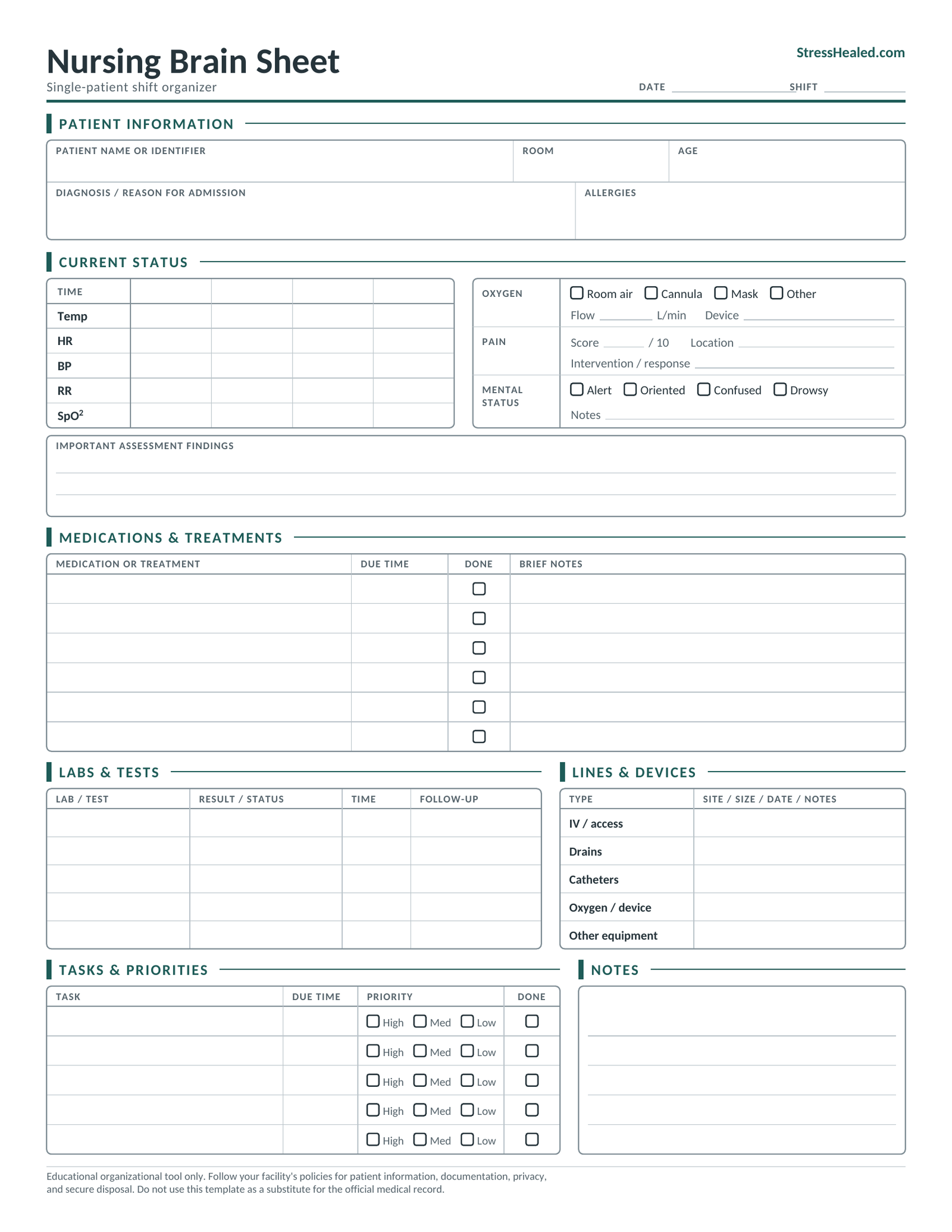
Preview of the free single-patient nursing brain sheet template.
Free Nursing Brain Sheet Template
This blank template gives you a simple way to organize patient information during a shift. Use it as a starting point and adapt it to your clinical workflow.
Download the brain sheet in the format that works best for you:
- PDF: Best for printing
- PNG: Quick visual reference
- DOCX: Editable Microsoft Word version
How to Use a Brain Sheet During Your Shift?
Start by reviewing the information you receive at the beginning of your shift. Write down the details you need to remember and arrange them.
Update your brain sheet throughout the shift as patient information or care needs change. You can:
- Mark completed tasks so you can quickly see what still needs attention.
- Organize priorities by marking time-sensitive or critical items, such as medication times, code status, pending tests, or changes in condition.
- Add follow-up reminders for tests, treatments, or other care that still needs action.
- Record important changes such as new vital signs, PRN medications given, or new findings, along with the time.
- Keep notes brief and clear so you can find important information quickly.
- Prepare for handoff by reviewing your sheet for unfinished tasks, recent changes, and other information the next nurse needs to know. Follow your unit’s approved handoff process when communicating this information.
Pro Tip: Use familiar abbreviations, arrows, and times instead of writing full sentences when appropriate. Make sure your notes are clear enough to explain aloud if needed.
What Should You Write Down When You Receive a New Patient?
When you receive a new patient, first record the details you need to understand their current condition and immediate care needs. Focus on information that helps you identify priorities and time-sensitive responsibilities for the shift.
- Patient identification: Name/identifier and room number.
- Reason for admission: Why the patient was admitted or transferred.
- Initial assessment: Key findings from the first assessment.
- Admission orders: New orders to review and complete.
- Allergies: Especially newly reported allergies or reactions.
- Initial medications: Home medications or newly ordered medications that need reconciliation.
- Pending admission tasks: Initial labs, tests, procedures, or assessments to be completed.
How Nursing Students Can Use a Brain Sheet in Clinicals
During clinicals, a brain sheet can help you prepare for patient care and keep track of what you need to learn throughout the day. Use it to jot down questions, observations, and reminders that support your learning.
You can also use it to prepare for discussions with your clinical instructor. Reviewing your notes before meeting with your instructor can help you identify gaps in your understanding and ask more specific questions about the patient’s care.
Follow your nursing program’s instructions for using a brain sheet. Clinical sites may also have rules about recording, storing, and disposing of patient information. Never include information that your school or clinical site does not allow you to record.
How Brain Sheets Differ by Unit
A brain sheet differs from one clinical unit to another because each setting has different patient needs, monitoring requirements, and daily workflows. The information on the page should match the type of care you provide.
- Med-Surg: Often focuses on routine assessments, medications, labs, and daily care tasks.
- ICU: Give more space for frequent assessments, trends, lines and devices, infusions, and ongoing changes in patient status.
- Emergency Department: May focus on rapid assessments, tests, treatments, reassessments, and disposition-related tasks.
- Pediatrics: It can include age- or weight-related information, intake and output, developmental considerations, and caregiver communication.
- Labor and Delivery: May emphasize maternal and fetal assessments, labor progress, medications, and time-sensitive events.
- Long-Term Care: Focus more on ongoing conditions, scheduled treatments, routine care, changes from baseline, and follow-up needs.
How Can a Brain Sheet Help You With Shift Handoff?
A brain sheet can make shift handoff easier by giving you a quick reference before you speak with the next nurse. Reviewing your notes helps you recall what happened during the shift and identify information that still needs to be communicated.
It can also help you structure your report so you move through the patient’s situation in a logical order instead of relying entirely on memory. This is especially useful after a busy shift when several events have occurred.
Use the brain sheet as a memory aid, not as the source of truth. Before giving report, verify important details against the patient’s current medical record and follow your unit’s approved handoff process. Never hand the next nurse your personal brain sheet unless your facility specifically permits it.
Privacy and Safe Handling
A brain sheet may contain protected health information (PHI), so handle it carefully and follow your facility’s privacy requirements.
- Write only what you need. Include information relevant to your work and leave out unrelated details, such as insurance information.
- Keep it secure. Do not leave the sheet unattended in public or shared areas. Take reasonable precautions to prevent unauthorized people from viewing it. HHS guidance on incidental disclosures
- Dispose of it properly. Use your facility’s approved process for destroying paper that contains PHI. HHS disposal guidance
- Do not take a brain sheet home. Keep it within the clinical setting and follow your facility’s approved process for storing or securely disposing of it after your shift.
- Check local requirements. Storage, transport, and disposal procedures can differ between facilities and nursing programs. Ask your instructor or unit educator if you are unsure.
HHS’s minimum necessary standard guides limiting certain uses and disclosures of PHI. It does not specify exactly what a nurse must include on a brain sheet.
Limitations: What a Brain Sheet Is Not
A brain sheet is an organizational aid, not a replacement for the patient’s official medical record. Use the electronic health record or other approved documentation system to verify current orders, medications, allergies, test results, and other clinical information. If your notes differ from the official record, stop and verify the information before relying on it.
A brain sheet does not have the same legal status in every setting. Nursing schools, employers, and healthcare facilities may have different rules for using and handling these sheets. Follow the rules that apply to your clinical setting rather than assuming that a brain sheet is part of the official medical record.
Research on brain sheets themselves is limited. Studies on structured communication tools suggest that organized formats can improve information exchange. However, this does not show that brain sheets themselves improve patient outcomes.
Frequently Asked Questions
Is a Brain Sheet the Same as a Nursing Report Sheet?
A brain sheet and nursing report sheet can refer to the same type of nursing worksheet, and many nurses use the terms interchangeably. Both can help organize patient information and shift responsibilities. However, some nurses or facilities use “report sheet” specifically for information used during shift-to-shift handoff, while “brain sheet” may refer more broadly to a personal shift-organizing tool. Terminology can vary by unit, school, or facility.
How Many Patients Can I Manage Using One Brain Sheet?
A multi-patient brain sheet often covers about 4 to 6 patients per page. The number can vary by template and clinical setting. More detailed sheets may cover fewer patients, while compact layouts can fit more. Choose a format that gives you enough space to record information clearly without overcrowding the page.
What If I Make a Mistake on My Brain Sheet?
If you make a mistake on a brain sheet, correct it according to your facility or nursing program’s policy. If the incorrect note could affect patient care, verify the information against the patient’s official medical record before relying on it. Never use a brain sheet to replace or alter an error in the official chart.
Does Using a Brain Sheet Replace Documenting in the EHR?
No. A brain sheet is a personal organization tool and does not replace documentation in the electronic health record (EHR). Use the EHR to complete required clinical documentation and keep the official patient record current. Use your brain sheet as a reminder, but document patient care in the medical record.
What are the most commonly used nursing brain sheet tools?
Nurses commonly use printable brain sheet templates, digital nursing apps, and customizable brain sheet builders to organize patient information and shift tasks. Popular options include NurseBrain, Nursing.com brain sheet templates, BrainSheet, and NurseBrain Synapse. The right tool depends on your nursing specialty, unit, and hospital’s policies.
References
- HHS. Minimum Necessary Requirement.
https://www.hhs.gov/hipaa/for-professionals/privacy/guidance/minimum-necessary-requirement/index.html - HHS. Incidental Uses and Disclosures.
https://www.hhs.gov/hipaa/for-professionals/privacy/guidance/incidental-uses-and-disclosures/index.html - HHS OCR. FAQs on Disposal of Protected Health Information.
https://www.hhs.gov/sites/default/files/disposalfaqs.pdf - Nurse.org. What is a Nursing Report Sheet? https://nurse.org/education/nursing-report-brain-sheet/
- LevelUpRN. What is a Nurse’s Brain Sheet? https://leveluprn.com/blogs/resources-for-nursing-students/nurses-brain-part-1
About the Author
John Watson founded StressHealed, a platform dedicated to evidence-based content on stress, wellbeing, and healthcare for nurses and frontline medical workers. John researches and writes about the healthcare system, from clinical workflows to workforce burnout, with content grounded in peer-reviewed studies, industry reports, and insights gathered directly from healthcare professionals.
Connect: stresshealed.com
Medical Disclaimer: This article is for educational purposes only and does not provide medical advice. A nursing brain sheet is an organizational aid and does not replace clinical judgment, the official medical record, or your facility’s policies. Always follow your employer or nursing program’s requirements for documentation, patient privacy, and patient care.