
Exercise and Workplace Stress: A Practical Guide for Office Workers
A colleague once told me she started taking short walks during her lunch break to step away from her desk for a few quiet minutes each day. At first, it seemed too simple to make much difference. Three months later, she handled one of the most stressful contract disputes of her career without losing her composure.
Her workload stayed the same. Her boss did not suddenly become easier to deal with. The only change was moving her body more consistently throughout the workweek. That small habit sparked a bigger conversation in her office about Exercise and Workplace Stress.
Exercise can be a practical way to manage stress because stress affects more than your thoughts and emotions. Your body responds too. This guide explains how regular movement may help with workplace stress, along with practical exercises and simple habits that can fit into a busy workday.
Recognizing the Signs of Workplace Stress
Workplace stress can show up in your body, emotions, thinking, and daily behavior. Recognizing these changes early can help you manage stress before it starts affecting your health, work, or relationships.
1. Physical Signs
Your body may respond to ongoing stress before you fully recognize how much pressure you are under. Common signs include:
- Persistent fatigue: Feeling tired even after getting enough sleep.
- Muscle tension and headaches: Frequent headaches, tight muscles, jaw tension, or other physical discomfort.
- Changes in heart rate: A racing or pounding heartbeat can occur during periods of stress or anxiety.
- Digestive symptoms: Stress can affect digestion, causing stomach discomfort, changes in bowel habits, or constipation.
2. Emotional Changes
Ongoing workplace pressure can affect your mood and emotional well-being. You may notice:
- Increased irritability: Becoming frustrated or short-tempered more easily than usual.
- Anxiety or uneasiness: Feeling tense, worried, or unable to relax after work.
- Lower motivation: Losing interest or enthusiasm for tasks you normally handle without much difficulty.
- Increased sensitivity: Reacting more strongly to criticism, workplace conflict, or everyday frustrations.
3. Changes in Thinking
High levels of stress can make it harder to focus and process information clearly. You may experience:
- Difficulty concentrating: Struggling to stay focused on tasks or conversations.
- Forgetfulness: Having trouble remembering details, deadlines, or routine tasks.
- Indecision: Finding it harder to make decisions, even about relatively simple matters.
- Racing or negative thoughts: Repeatedly thinking about work problems or expecting something to go wrong.
4. Behavioral Changes
Stress can also change how you behave at work and outside of it. Some signs include:
- Social withdrawal: Avoiding coworkers, team activities, or conversations you would normally participate in.
- Skipping breaks: Working through lunch or regularly staying at your desk without taking time to recover.
- Overworking: Feeling unable to disconnect from work or regularly working beyond your normal hours.
- Neglecting self-care: Cutting back on exercise, sleep, hobbies, or other activities that support your well-being.
- Difficulty adapting: Becoming more frustrated by changes or unexpected demands at work.
Want to get a better sense of your current stress level? Try the Stress Level Checker to reflect on how daily pressure may be affecting your well-being.
Preventing Work-Related Musculoskeletal Disorders and Repetitive Strain Injuries
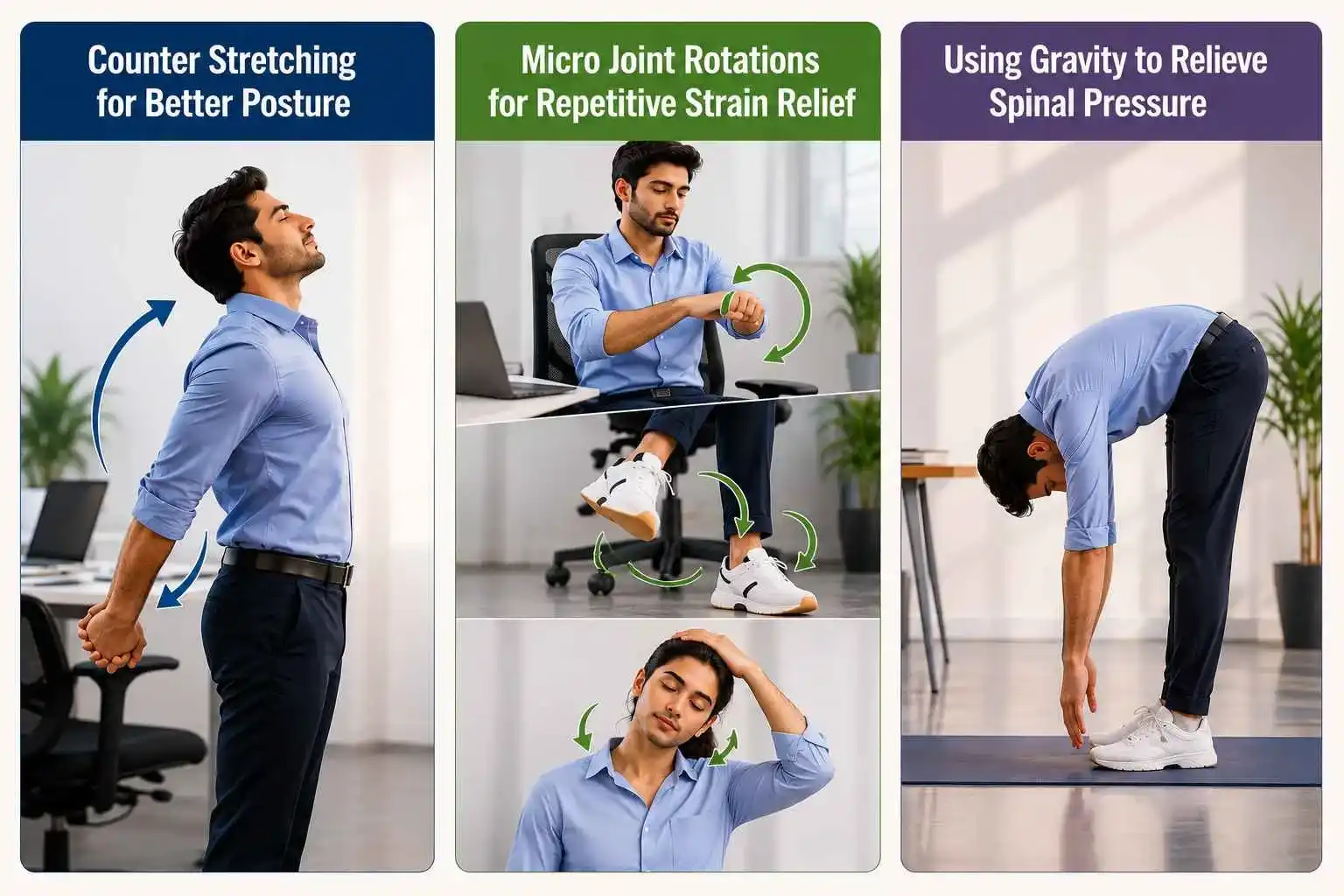
Preventing Work-Related Musculoskeletal Disorders and Repetitive Strain Injuries
Long hours at a desk can contribute to work-related musculoskeletal disorders (WMSDs), especially when you stay in the same position for long periods or repeat the same movements throughout the day. Office workers often experience neck and shoulder tension, lower back discomfort, and wrist or hand problems associated with prolonged computer use and repetitive tasks.
Regular movement and simple stretches can help reduce stiffness and make long periods of desk work more comfortable. Try these three habits during the workday:
Counter Stretching for Better Posture: Desk work can encourage you to lean forward, round your shoulders, and stay in one position for too long. Stand up, gently bring your hands behind your body, and draw your shoulders back without forcing the movement. This can stretch the chest and shoulders after prolonged sitting.
Gentle Joint Movements for Repetitive Strain: Typing and other computer tasks require repeated hand and wrist movements, while your neck may stay in one position for extended periods. Gentle wrist circles, ankle rotations, and gentle neck movements can help break up long periods of stillness and reduce stiffness. Take regular movement breaks rather than waiting until you feel uncomfortable.
Gentle Movement for Lower Back Stiffness: Sitting for long periods can leave the lower back feeling tight or uncomfortable. At the end of a work period, try a gentle standing forward fold by bending from your hips and allowing your upper body to relax only as far as feels comfortable. Do not force the stretch or continue if it causes pain.
Exercise at Your Desk: No Gym, No Equipment, No Excuses
This is where things get practical. These exercises are designed for real workplaces, including offices, cubicles, and open-plan floors where you probably do not want to start doing burpees in front of your coworkers.
2-Minute Reset (At Your Desk, No Standing Required)
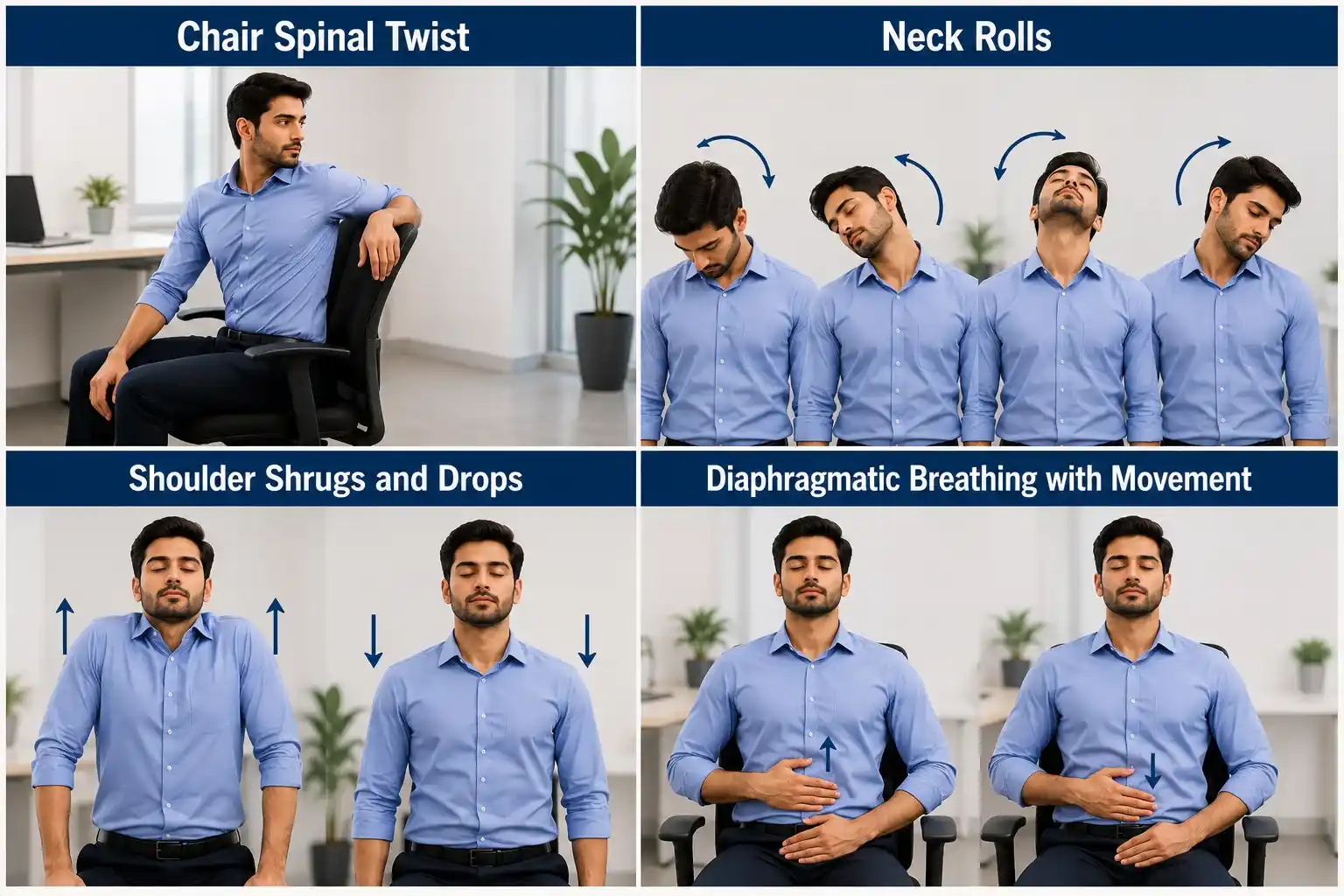
Do this when you feel tension building, but cannot leave your workspace.
Chair Spinal Twist: Sit tall with your feet flat on the floor. Place your right hand on the back of your chair and gently rotate your torso to the right. Hold for about 20 to 30 seconds, then return to the starting position and switch sides. This movement gently rotates the upper body and can help ease stiffness after long periods of sitting.
Neck Rolls: Lower your chin gently toward your chest, then slowly turn your head to the right. Return to the center, then slowly turn to the left. Do three slow rotations in each direction. Do not force the movement.
Shoulder Shrugs and Drops: Raise both shoulders toward your ears, hold for five seconds, then drop them as low as possible and hold for five more seconds. Repeat five times. This is one of the fastest ways to relieve shoulder tension caused by desk work.
Diaphragmatic Breathing with Movement: Place one hand on your belly and breathe in slowly for four counts, allowing your abdomen to expand. Then breathe out for six counts while gently relaxing your belly. Repeat for five slow breaths, keeping your breathing steady and comfortable.
5-Minute Active Break (Standing, Small Space)
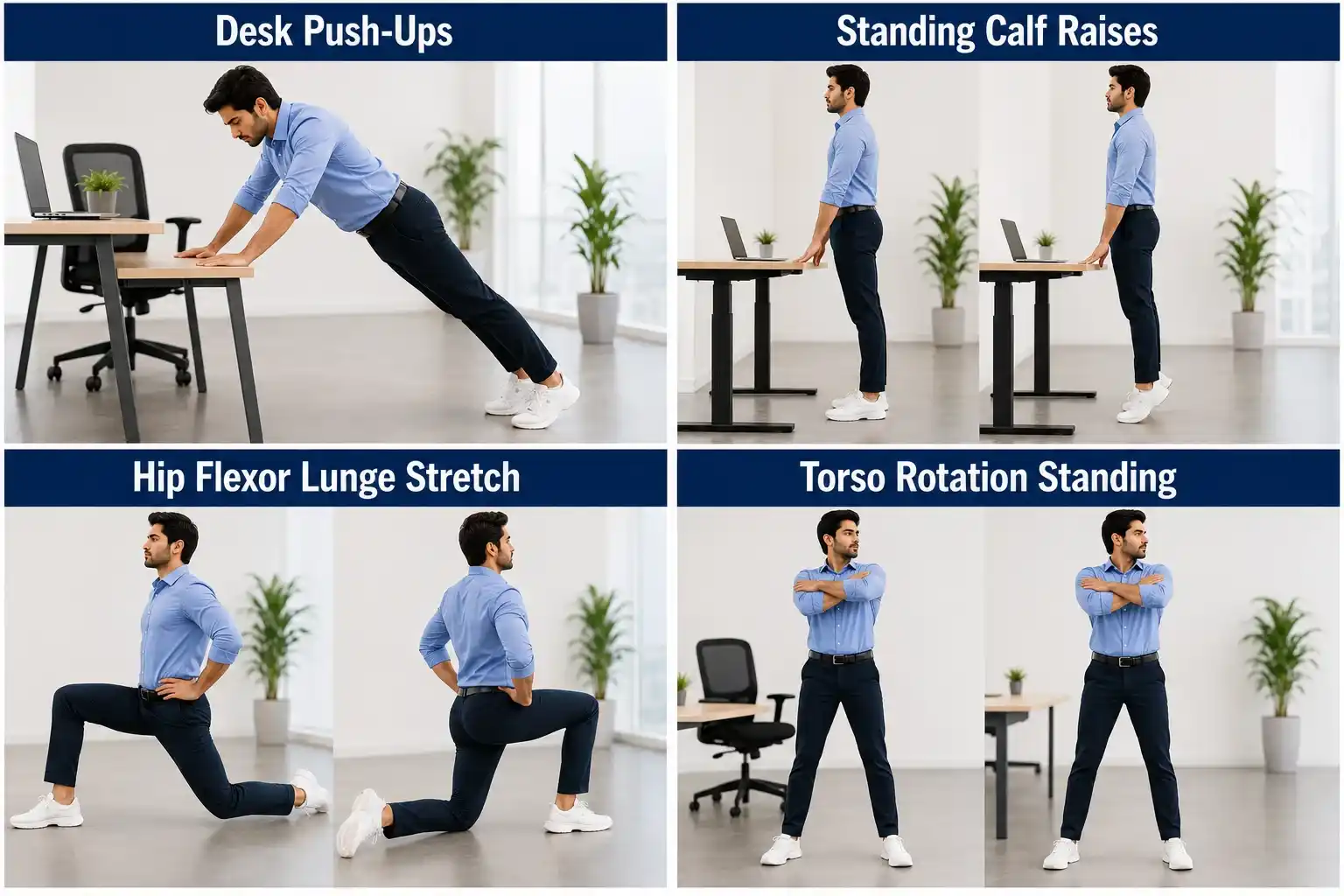
Use this during a screen break, after a meeting, or whenever you need to reset without leaving the floor.
Desk Push-Ups: Place your hands on the edge of a sturdy desk, about shoulder-width apart, and step back until your body forms a slight diagonal. Bend your elbows to lower your chest toward the desk, then push back to the starting position. Start with 8 to 10 repetitions and stop if you feel pain or discomfort. This movement works your chest, shoulders, arms, and core.
Standing Calf Raises: Rise onto your toes, hold for two seconds, then slowly lower your heels. Repeat 10 to 20 times. Do these while reading an email or waiting for something to load.
Hip Flexor Lunge Stretch: Step one foot forward into a shallow lunge. Lower your back knee gently toward the floor and keep your torso upright as you feel a stretch along the front of your hip. Hold for about 20 to 30 seconds per side.
Torso Rotation Standing: Stand with your feet hip-width apart and your arms crossed over your chest. Slowly rotate your upper body to the left, return to center, then rotate to the right. Repeat 10 times on each side. This gentle movement helps loosen the upper back and can break up stiffness.
10-Minute Movement Break (Hallway, Stairwell, or Outside)
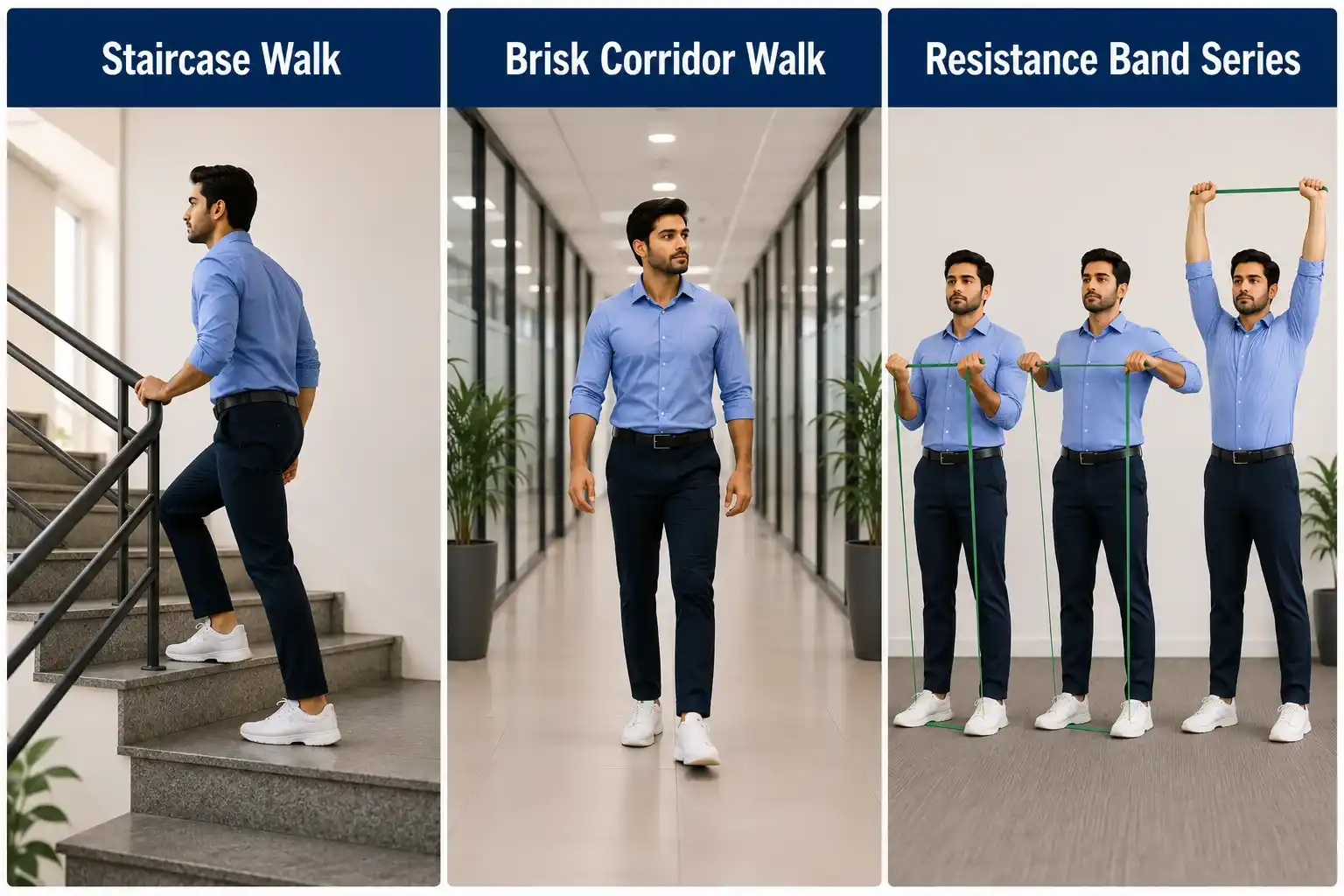
If you can get ten minutes away from your desk, this is your most powerful mid-day reset.
Staircase Walk: Walk up and down the building stairs for about five minutes at a brisk but comfortable pace. It adds aerobic movement to your workday, raises your heart rate, and gives you a chance to step away from your screen.
Brisk Corridor Walk: Walk around your building or office floor for about 10 minutes at a comfortable, purposeful pace. Keep your head up, relax your shoulders, and let your arms move naturally as you walk.
Resistance Band Series: Keep a light resistance band in your desk drawer. In a private space, try bicep curls, rows, and overhead presses. Start with some repetitions, using controlled movements rather than rushing through the exercises. Resistance training adds variety to your workday movement and can give you a focused break from work-related tasks.
7 Best Morning Exercises for Workplace Stress Relief
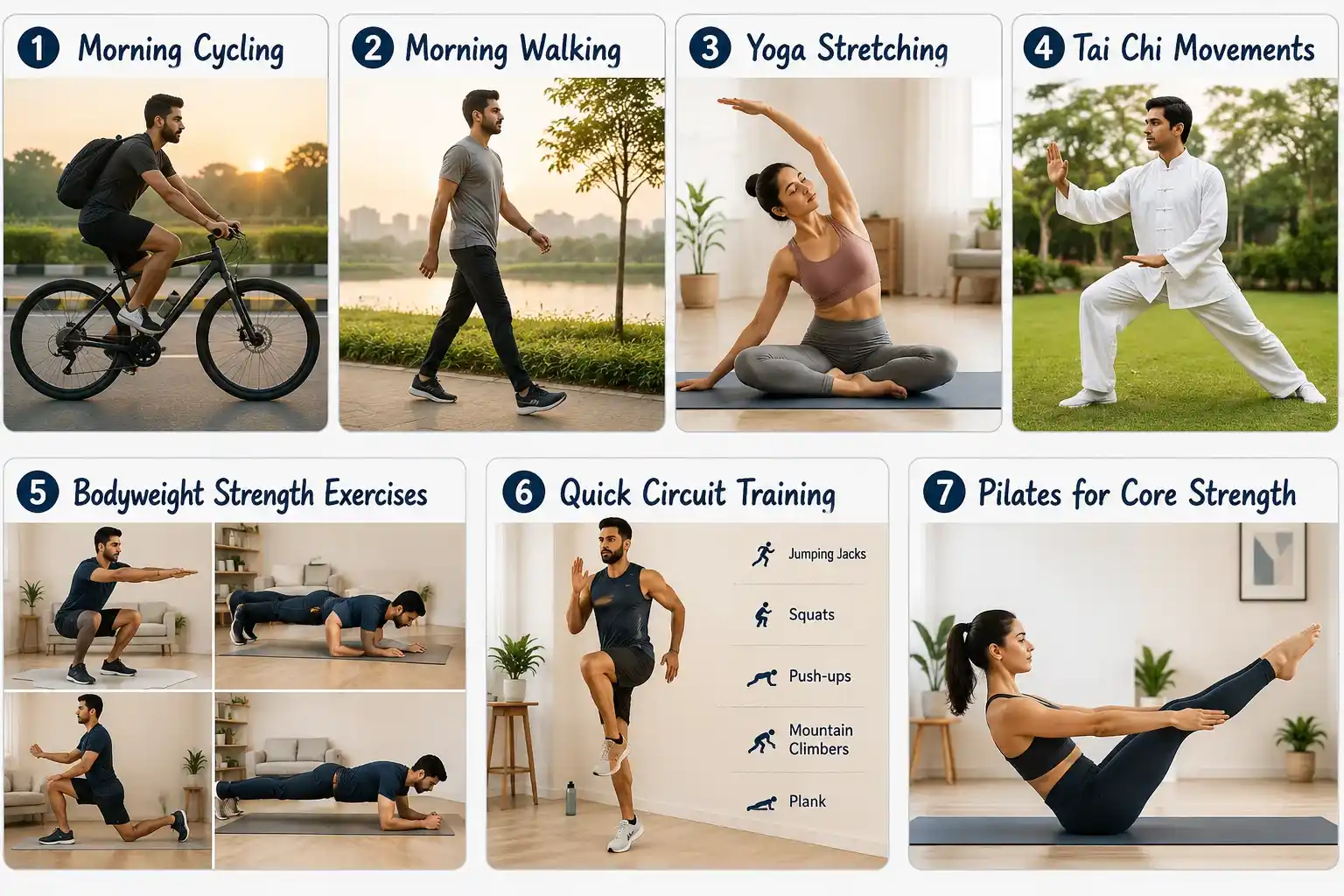
Here is a quick-reference list of simple morning exercises office workers can do before starting their workday.
- Morning Cycling: Ride a bike for 15 to 30 minutes before work to improve circulation.
- Morning Walking: Take a brisk 10 to 20-minute walk before work to help your body and mind wake up naturally.
- Yoga Stretching: Spend 10 minutes doing gentle yoga stretches focused on the back, shoulders, and hips.
- Tai Chi Movements: Practice simple Tai Chi movements for 10 minutes in a quiet space.
- Bodyweight Strength Exercises: Perform 10 to 15 minutes of squats, push-ups, lunges, or planks to activate your muscles.
- Quick Circuit Training: Complete a short 15-minute circuit using light cardio and bodyweight exercises.
- Pilates for Core Strength: Follow a beginner Pilates routine to improve posture and reduce stiffness.
Managing Workplace Stress Through Psychological Strategies
Combining physical movement with simple psychological strategies helps employees handle daily pressure more effectively. These habits do more than get through one stressful day. They help create a calmer mindset that makes everyday work challenges easier to manage.
Here are a few key strategies to tackle workplace stress and stay balanced.
How Stress Attacks Your Identity at Work
Constant pressure can slowly damage confidence and create negative self-talk. Over time, many employees start believing stressful thoughts like:
- Self-Doubt: “I am not performing well enough.”
- Comparison: “Others are more capable than I am.”
- Fear of Failure: “I’m losing control of my responsibilities.”
If you don’t intervene, these thoughts become your “identity,” making your work life feel like a permanent struggle. This is where the psychological power comes in; it helps you break these negative patterns and reclaim your sense of self.
How Exercise Rebuilds the Internal Story
Regular physical activity acts as a “proof of concept” for your mind. Each workout is a small victory that challenges negative internal narratives. By tracking physical changes, whether through a BMI calculator or simply noticing increased stamina, you make progress visible, reinforcing the belief that growth is always possible.
Over time, this helps you adopt a much stronger professional identity:
- Discipline: “I am someone who sticks to a routine.”
- Resilience: “I can handle physical and mental difficulty.”
- Growth Mindset: “I improve consistently with effort.”
- Reliability: “I finish what I start.”
This internal shift doesn’t just make you “fitter”; it builds the psychological resilience needed to handle high-pressure demands with absolute confidence.
How Journaling Helps to Release Mental Pressure
Journaling helps employees release built-up thoughts and emotions. Writing down worries, frustrations, or stressful experiences can clear mental overload and make difficult situations feel easier to handle. Many people journal after stressful meetings or demanding workdays to organize their thoughts and mentally reset before moving forward.
Read this guide to understand the 42% burnout rule and learn simple ways to manage workplace stress before it starts affecting your mental and physical well-being.
How Exercise Affects Stress
Exercise can influence several processes involved in mood, attention, and the body’s response to pressure.
- Endorphins: Physical activity can increase endorphins. These chemicals are linked to feelings of well-being and can help regulate pain.
- Brain chemistry: Exercise interacts with neurotransmitter systems such as serotonin and dopamine, which play roles in mood, motivation, and attention.
- Cortisol and adrenaline: These hormones are part of the body’s normal response to pressure. Regular physical activity may help support a healthier response to repeated stress rather than simply “flushing out” these hormones.
- Nervous system: Movement affects the autonomic nervous system and can provide a physical and mental break during a demanding workday.
- BDNF: Exercise is associated with changes in brain-derived neurotrophic factor (BDNF), a protein involved in learning, memory, and brain health.
Related: Workplace stress in working moms
How Exercise in the Workplace Supports Employee Mental Health
Exercise can support employee mental health. It may reduce stress, improve mood, and help employees recover after a demanding workday. For employers, workplace exercise programs can also create a more active, supportive work environment.
- Fewer Missed Workdays: Making physical activity easier to access may support overall health and reduce absenteeism.
- Better Focus: Short activity breaks let employees step away from demanding tasks and return with renewed attention.
- Employee Morale: Walking groups, movement breaks, or fitness benefits can show employees that their employer values their health and quality of work life.
Practical Implementation for Employers
You do not need to build a corporate gym to launch a workplace physical activity program. Here are low-cost, high-impact approaches:
- Post stretch guides: Place simple stretch guides at workstations.
- Schedule movement breaks: Add five-minute breaks at 11 AM and 3 PM.
- Allow walking meetings: Use walking meetings for suitable discussions.
- Offer standing desks: Provide shared or adjustable standing workstations.
- Create a movement space: Set aside a small area for stretching.
- Offer fitness support: Provide a gym subsidy or fitness stipend.
- Encourage stair use: Promote stairs when they are safe and accessible.
- Run optional activities: Offer walking groups, stretching sessions, or activity challenges.
- Lead by example: Encourage managers to take movement breaks too.
- Protect break time: Make sure workloads allow employees to step away and move.
Avoid adding pressure: A workplace fitness program should encourage movement, not create another performance target. Requiring employees to hit 10,000 steps or risk falling behind a team ranking could increase stress instead of reducing it.
Frequently Asked Questions
How does virtual reality help reduce workplace stress?
Virtual reality (VR) uses a headset to create an immersive digital environment. Instead of simply watching a video on a screen, you can look around and interact with a computer-generated setting as if you were inside it.
For workplace wellness, VR can provide a short break from a stressful environment. Programs may offer guided breathing, meditation, calming nature scenes, relaxation exercises, or virtual movement sessions. An employee might use a VR headset during an approved break to step away from work demands and focus on a calming activity.
How Does 30-Minute Laughter Yoga Help Reduce Workplace Stress?
Laughter yoga combines intentional laughter, breathing exercises, and simple movements. A 30-minute session can be a social break from work demands, and participants may feel more relaxed and positive afterward.
What is Non-Sleep Deep Rest (NSDR) and how can it help with workplace stress?
Non-Sleep Deep Rest (NSDR) is a guided relaxation practice in which the body and mind enter a deeply restful state without falling asleep. It can involve techniques such as focused breathing, body awareness, and guided relaxation. Some people use NSDR after mentally demanding activities as a way to rest and reset without taking a full nap.
What Exercises Can I Do After Sitting Through Back-to-Back Meetings?
After several hours of meetings, try simple movements that break up prolonged sitting. Easy options include shoulder rolls, gentle neck turns, seated spinal twists, calf raises, and a short walk. You can also try a gentle hip flexor stretch if your hips feel tight. Keep each movement comfortable and stop if it causes pain.
What If I Don’t Enjoy Exercise?
You do not need to enjoy traditional workouts to move more during the workday. Start with manageable options, such as taking a short walk, using the stairs, stretching between tasks, or standing during part of a meeting. Choose movements you can fit naturally into your routine rather than forcing yourself into an exercise program you dislike.
What If I Have a Physical Limitation or Health Condition?
If you have a health condition, injury, or physical limitation, you may need to adjust your activity level or choose exercises that are easier on your body. Talk with your healthcare professional or physical therapist before starting a new exercise routine. They can help you choose safe activities based on your needs and abilities.
Bottom Line
Workplace stress may be part of life, but you do not have to ignore its effects. Regular movement is a practical way to step away from work demands, release some physical tension, and reset during a busy day. You do not need a complicated workout routine to get started. Take a short walk, stretch between tasks, use the stairs, or try one of the simple exercises in this guide. Choose something you can realistically maintain and build from there.
Want to learn more about your health and daily wellness? You can also use our free Calorie Calculator to estimate your daily calorie needs.
Reference
- World Health Organization (WHO). Guidelines on Physical Activity and Sedentary Behaviour.
https://www.who.int/publications/i/item/9789240015128 - Centers for Disease Control and Prevention (CDC). Benefits of Physical Activity.
https://www.cdc.gov/physical-activity/php/about/index.html - National Institute for Occupational Safety and Health (NIOSH). Stress at Work.
https://www.cdc.gov/niosh/stress/about/index.html - National Institute for Occupational Safety and Health (NIOSH). Work-related Musculoskeletal Disorders.
https://www.cdc.gov/niosh/ - American Psychological Association (APA). Stress in America.
https://www.apa.org/news/press/releases/stress - Mayo Clinic. Exercise and stress: Get moving to manage stress.
https://www.mayoclinic.org/healthy-lifestyle/stress-management/in-depth/exercise-and-stress/art-20044469 - National Center for Complementary and Integrative Health (NCCIH). Relaxation Techniques: What You Need To Know.
https://www.nccih.nih.gov/health/relaxation-techniques-what-you-need-to-know
About the Author
John Watson founded StressHealed, a platform dedicated to evidence-based content on stress, wellbeing, and healthcare for nurses and frontline medical workers. John researches and writes about the healthcare system, from clinical workflows to workforce burnout, with content grounded in peer-reviewed studies, industry reports, and insights gathered directly from healthcare professionals.
Connect: stresshealed.com
Disclaimer: This article is intended for general education and wellness awareness. Exercise may not be appropriate for everyone. If you have an injury, medical condition, ongoing pain, or concerns about physical activity, seek advice from a qualified healthcare professional before trying new exercises.
If you are a health expert, you can Write For Us and share your expertise with our readers.