Gout in Women vs Men: Key Differences You Should Know
Research shows a clear gap between the sexes in this condition. Gout affects around 5.9% of men and just 2% of women in the United States, according to research published through the National Institutes of Health. That gap narrows with age, though. Women tend to develop gout later in life, often alongside other health conditions that men are less likely to have at the same stage.
So why does this matter? Understanding gout in women vs men helps explain why symptoms, risk factors, and even treatment approaches can look different depending on your sex. Hormones shape uric acid levels differently in men and women.
Kidney function and daily habits add another layer to the picture. Once you see how these pieces fit together, it becomes easier to spot warning signs early and talk to your doctor with real confidence.
The History of Gout and How Common It Is in Women vs Men
The word “gout” comes from the Latin term “gutta,” meaning “drop.” During medieval times, doctors believed the condition was caused by drops of harmful fluids collecting inside the joints. However, gout is far from a modern disease. Ancient Egyptian records mention symptoms that may have been linked to gout, while the Greek physician Hippocrates later described the painful big toe attack known as “podagra.”
According to the Arthritis Foundation, cases of gout have more than doubled among women over the last 20 years. Today, more than 3 million women and 6 million men in the U.S. live with this inflammatory form of arthritis.
For centuries, people called gout the “disease of kings.” The name stuck because it was mostly seen among the wealthy. It’s now one of the most common causes of inflammatory arthritis in the United States.
Experts link this rise to increasing rates of obesity, high blood pressure, and other metabolic health factors. So while men still account for a larger share of gout cases, the difference between the sexes is becoming smaller. Women can also develop gout, especially as risk increases with age and hormonal changes after menopause.
Why Age of Gout Onset Differs Between Men and Women
The differences between gout in women and men go beyond how often it occurs. Age plays a bigger role here than most people realize.
Men typically develop gout earlier, often in their 30s and 40s. Men face a notably higher risk during this age range, while women generally don’t face the same risk until later in life. This is one reason gout got labeled a “young man’s problem” for so long.
Women usually don’t see their first gout flare until after menopause, typically in their 50s or 60s. Before that stage, gout in women is fairly rare.
So what protects women earlier in life? The answer comes down to one hormone: estrogen.
- Estrogen helps protect women against gout by promoting more efficient kidney excretion of uric acid.
- This is why gout has historically been rare in women before menopause, since estrogen levels stay higher during those years.
- Once estrogen drops, that natural protection fades, and uric acid has more chance to build up in the blood.
How Gout Symptoms Differ in Men and Women
Gout doesn’t always look the same from one person to the next. Knowing the common patterns can help you recognize gout earlier rather than mistaking it for another condition.
Common Symptoms in Men
Men tend to experience a more classic version of gout. Their attacks usually follow a predictable pattern:
- Sudden, intense flares. Men are more likely to have recurrent gout attacks that come on quickly and intensely.
- Podagra as the first sign. Men have a higher rate of podagra, the sharp, burning pain in the big toe that most people associate with gout.
- Fewer joints involved. Gout in men typically affects the big toe and remains confined to that one joint at first.
Common Symptoms in Women
Women often experience a quieter, slower-moving version of the same disease, and that difference has real consequences.
- Slower onset, more gradual pain. Women tend to develop symptoms that build up over time rather than strike suddenly, and pain in multiple joints is more common than one sharp attack.
- Multiple joints affected. Women may experience gout in the knees, wrists, fingers, and ankles, not just the big toe. Women are also less likely to have podagra and more likely to have several joints involved during an attack.
- Mistaken for other conditions. Because women’s symptoms often present in the fingers, wrists, or knees, doctors may mistake gout for rheumatoid arthritis or osteoarthritis.
- Delayed diagnosis. This atypical joint involvement can lead to misdiagnosis or a delayed diagnosis of gout in women. The Arthritis Foundation compares this pattern to how heart attacks are sometimes missed in women because their symptoms can be less typical and easier to overlook.
Gout Causes and Risk Factors: Men vs Women
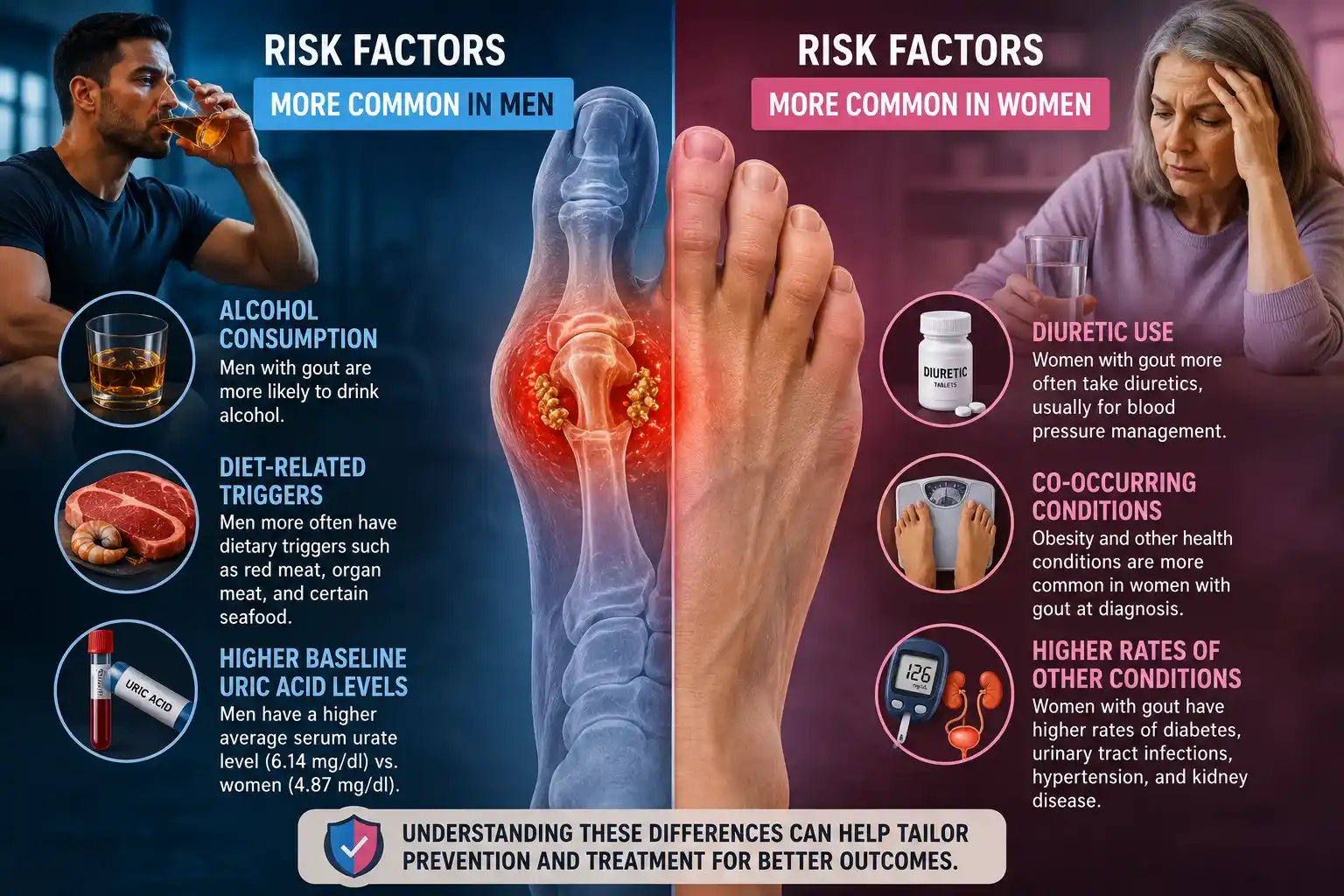
Some gout triggers overlap between the sexes, but several risk factors clearly stand out more in one group than the other. Comparing these differences helps explain why men and women often need different prevention strategies.
Risk Factors More Common in Men
- Alcohol consumption. Men with gout are more likely to drink alcohol than women with the condition.
- Diet-related triggers. Men more often have dietary triggers tied to their gout flares compared to women. Purine-rich foods like red meat, organ meat, and certain seafood fall into this category.
- Higher baseline uric acid levels. Men have a higher average serum urate level than women, at 6.14 mg/dl compared to 4.87 mg/dl. This baseline difference partly explains why gout shows up earlier and more often in men.
- Protein and workout supplements. These may influence uric acid levels in some individuals, but current evidence does not prove that they directly cause gout. A case report observed elevated uric acid and creatinine levels in a male athlete who regularly consumed whey protein, creatine supplements, and a high-protein diet. However, the researchers noted that a single case cannot establish a definite cause-and-effect relationship.
Risk Factors More Common in Women
- Diuretic use. Women with gout more often take diuretics than men, usually for blood pressure management. Diuretic use tends to be more frequent in women with gout overall, not just at diagnosis.
- Co-occurring conditions. Obesity and other health conditions tend to be more common in women with gout than in men at the time of diagnosis. Women with gout also show higher rates of diabetes and urinary tract infections compared to men with the condition. Hypertension and kidney disease are common health conditions that can increase the risk of gout.
Related Health Risks: Gout’s Connection to Other Conditions
Gout rarely occurs on its own. It is often associated with other health conditions that can influence its severity and management.
In Women
Women with gout show a significantly higher likelihood of heart failure, diabetes, obesity, and urinary tract infections compared to men with the condition. Research has also found that women with gout face a 39% higher risk of heart attack compared to women without gout.
This pattern matters for a few reasons:
- Heart failure risk may go unnoticed if doctors focus only on joint symptoms.
- Diabetes and obesity often develop as part of the same metabolic picture that raises uric acid levels in the first place.
- Urinary tract infections add another layer of complexity, especially for women already managing kidney-related risk factors tied to gout.
In Men
Men with gout tend to develop respiratory disease, heart disease, and peripheral artery disease at higher rates than women with the condition.
These risks often overlap with common cardiovascular concerns men already face as they age, which makes regular checkups even more important once a gout diagnosis enters the picture.
Why this matters: These aren’t just side notes. A gout diagnosis can be an early signal to screen for other conditions, especially since some of these risks (like heart disease) can be more serious than the joint pain that brought someone to the doctor in the first place.
Related Posts
- Best Natural Diet for Gout Pain Relief: A Practical Food Guide
- Stress and Gout: Can Stress and Anxiety Trigger Gout Flare-Ups?
Diagnosis: What to Expect Regardless of Sex
A gout diagnosis usually follows the same basic process for everyone, though women may need extra steps along the way.
Your doctor will examine the affected joint and may order a blood test to check uric acid levels. If needed, a joint fluid analysis or imaging tests, such as an ultrasound or X-ray, can help confirm the diagnosis and rule out other conditions.
Why women may need a more thorough workup
Women may experience gout symptoms in the fingers, knees, or other joints, which can make the condition harder to recognize. Because of this, diagnosing gout may take longer, and it can sometimes be mistaken for arthritis or other joint conditions.
If your symptoms are persistent or unexplained, ask your healthcare provider whether a uric acid blood test or joint fluid analysis is appropriate. According to the Arthritis Foundation, these tests can help confirm or rule out gout when the diagnosis is unclear.
Gout Prevention: Men vs Women Comparison Table
Prevention looks different for men and women, since each group faces different risk factors. Use this quick comparison to see where your focus should be.
| Prevention Focus | For Men | For Women |
|---|---|---|
| Alcohol | Limit or avoid alcohol, especially beer and spirits, since men with gout are more likely to drink alcohol than women with the condition. | Moderate alcohol intake still matters, though it’s a smaller risk driver compared to other factors. |
| Diet | Cut back on purine-rich foods like red meat, organ meat, and certain seafood, since men more often have dietary triggers tied to their gout flares. | Follow a balanced, low-purine diet as a general precaution, with less emphasis needed on this specific trigger. |
| Hormonal changes | Not a major factor for men. | Talk to a doctor about monitoring uric acid levels around menopause, since estrogen decline reduces natural protection against gout. |
| Medication review | Review any long-term medications with a doctor as part of routine care. | Ask a doctor to review diuretic use for blood pressure, since women with gout more often take diuretics than men. |
| Weight management | Maintain a healthy weight through diet and activity. | Prioritize weight management closely, since obesity tends to be more frequent in women with gout than in men at diagnosis. |
| Managing other conditions | Monitor cardiovascular health, since men face higher rates of heart disease and peripheral artery disease alongside gout. | Monitor blood pressure, blood sugar, and kidney function closely, since women with gout show higher rates of diabetes, obesity, and urinary tract infections. |
| Hydration | Drink plenty of water daily to help the kidneys flush out uric acid. | Drink plenty of water daily, same as men. |
| Routine checkups | Get uric acid levels checked periodically, especially after age 30. | Get uric acid levels checked periodically, especially approaching and after menopause. |
Since weight management plays a direct role in gout risk for both women and men, it’s worth knowing where you stand. Try our BMI calculator to check your numbers and see if weight is a factor worth addressing.
Does Gout Treatment Differ Between Women and Men?
Research shows that core medications like colchicine, NSAIDs, and steroids get prescribed at similar rates in women and men. The drugs themselves don’t change. What shifts is the monitoring around them.
If you’re in the middle of a flare right now, our guide on immediate gout pain relief in the first 24 hours walks through exactly what to do.
Why women may need closer monitoring:
- Women tend to be older at diagnosis and carry a higher burden of conditions like obesity, hypertension, and diuretic use.
- These factors can affect how doctors start or adjust urate-lowering therapy for women.
- The focus stays on how these medications interact with other conditions a woman may already be managing, not on prescribing different drugs altogether.
Bottom Line
Prevention doesn’t require a perfect routine, just a consistent one. The habits that matter most are the ones you actually stick with long term, not the ones that look good on paper for a week. Genetics and age play a role too, so even careful prevention won’t guarantee you’ll never see a flare. That’s normal, and it doesn’t mean your efforts aren’t working.
If symptoms show up despite your best efforts, that’s your cue to loop in a doctor rather than manage it alone, since catching a flare early makes it easier to treat and keeps long-term joint damage off the table.
Frequently Asked Questions
What is the ratio of gout in men vs women?
Gout affects roughly three to four times more men than women. This gap narrows with age, though, since women’s risk rises significantly after menopause while men’s risk stays relatively steady across adulthood.
Where is gout most prevalent globally?
Based on the most recent Global Burden of Disease data, the United States has the highest age-standardized point prevalence of gout in the world, at 1,752 cases per 100,000 people, followed by New Zealand and Canada. This data also showed that the United States had the largest increase in gout prevalence between 1990 and 2019, rising by 85.8%.
What is the biggest culprit of gout?
High uric acid levels, known as hyperuricemia, are the biggest culprit behind gout. This buildup happens either because the body produces too much uric acid or the kidneys can’t clear it efficiently enough.
Is gout a lifelong condition?
Yes, if left untreated, gout can become a lifelong condition with recurring flares and joint damage. However, with proper treatment, most people manage it effectively and prevent long-term damage.
How can I lower my uric acid in 7 days?
There’s no guaranteed way to drop uric acid significantly in just 7 days, but these habits can help move things in the right direction: cut back on alcohol and sugary drinks, limit purine-rich foods like organ meat and red meat, drink more water, and add low-fat dairy and vegetables to your diet. For persistently high levels, talk to a doctor about medication, since diet alone often isn’t enough.
References
- Gout Across Genders: Prevalence, Diagnosis, and Management.
- Symptoms of Gout in Woman: Explaining Differences and Causes.
- National Center for Biotechnology Information (NCBI).
- Gout Affects Women Differently.
- Gout in Women vs Men: Key Differences.
- Elevated Creatinine and Uric Acid in a Male Athlete: A Case Report
Disclaimer: This information is for educational purposes only and isn’t a substitute for professional medical advice. Always consult a doctor for diagnosis and treatment.