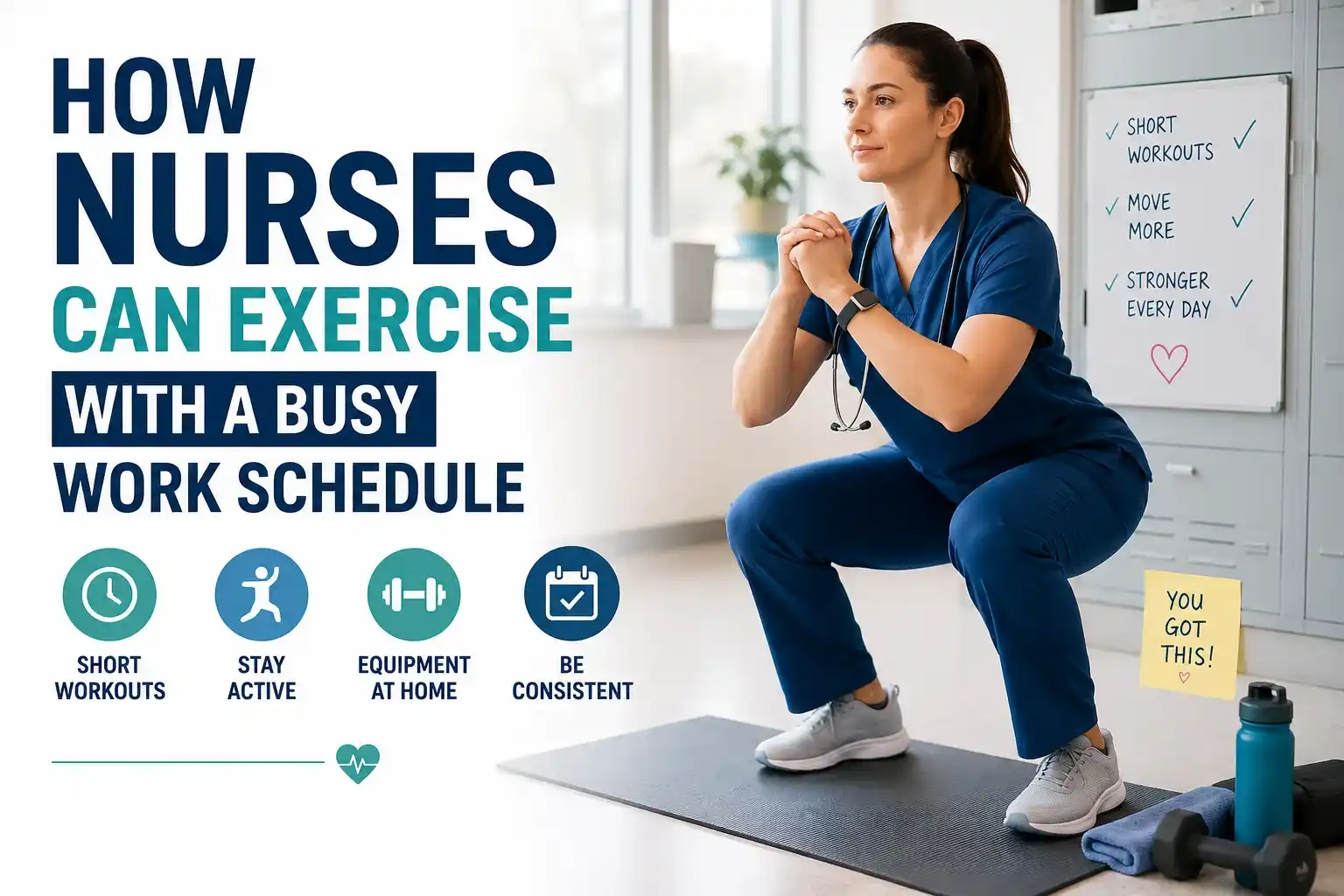
How Nurses Can Exercise with a Busy Work Schedule After Long Shifts
A nurse once told me something I still remember: “I spend all day caring for everyone else, then come home with nothing left for myself.” That one sentence explains why so many healthcare workers struggle with staying active, even when they understand how important movement is for their health.
Long shifts, rotating schedules, emotional stress, aching feet, and pure exhaustion can make self-care feel impossible. But learning How Nurses Can Exercise with a Busy Work Schedule is not about forcing yourself into exhausting gym routines after a 12-hour shift. It is about finding realistic habits and simple exercises for nurses that fit into real hospital life.
Here is the most important thing this guide can tell you: imperfect consistency beats perfect inconsistency every single time.
Many nurses ignore the early signs of burnout until stress begins affecting sleep, energy, and mental health. Use our Stress Level Checker before workplace stress becomes intense.
Why Nurses Struggle With Exercise
Nursing is one of the most physically demanding professions in America. You already lift, bend, walk, and spend hours on your feet every shift. That is why conversations about exercise and workplace stress feel frustrating for many nurses. When someone casually says, “Just do 30 more minutes of cardio,” it can sound completely disconnected from real nursing life.
The reality is that nurse burnout and physical fatigue create a cycle that makes traditional fitness advice completely unworkable. A Harvard Nurses’ Health Study found that more than 50% of nurses exercise for less than two hours per week, most often due to long hours and inconsistent schedules.
That is not failure. That is a scheduling problem that nobody has solved for nurses, until now.
If you are an ICU nurse, the daily stress you face may be more dangerous than you realize.
Why Exercise Matters for Nurses
Still unsure whether nurses should work out before or after shifts? This video breaks down real experiences, energy levels, stress, and workout timing for busy nursing schedules.
Most fitness content for nurses leans on the same tired message: exercise to stay healthy and feel better. That is true, but it is not nearly motivating enough when you are running on four hours of sleep.
Here are three reasons that actually matter to a nurse’s career and body:
Exercise is injury armor. The Bureau of Labor Statistics reports that registered nurses and nursing assistants consistently rank in the top 10 occupations for work-related musculoskeletal disorders, including back injuries, shoulder strain, and knee damage. Strengthening your core, posterior chain, and hip flexors directly reduces the risk of getting hurt on the job.
Exercise fights burnout at the chemical level. When you exercise, your body lowers stress hormones like cortisol and adrenaline while boosting feel-good chemicals called endorphins. For nurses dealing with constant workplace stress, exercise is not just about fitness. It is one of the simplest ways to support your mental and physical health.
Exercise extends your career. The nurses who stay physically capable and injury-free into their 40s and 50s are almost always the ones who built movement habits early. Fitness is not about looking good in scrubs. It is about being able to keep doing the work you love for as long as you choose.
Related: Worst Nursing Mistakes
The Science Behind Exercise Snacking
Exercise snacking is the practice of breaking physical activity into short bouts of 2 to 5 minutes spread throughout the day. Multiple peer-reviewed studies have shown that these short sessions produce cardiovascular and metabolic benefits that can be just as effective as one longer workout.
You are not a person who has no time to exercise. Your nursing shifts already include natural movement opportunities throughout the day. The challenge is learning to see them.
Here is what exercise snacking looks like inside a nursing shift:
- Between patient rounds: 10 calf raises at the nurses’ station.
- Waiting for an elevator: wall sit for 60 seconds.
- During a medication check: standing core holds or glute squeezes.
- On a 15-minute break: a brisk stairwell walk or a quick bodyweight circuit in the break room.
- At handoff: a standing stretch sequence for your thoracic spine and hip flexors.
You do not need a gym. You do not need a 45-minute block. You need nine five-minute windows, and your shift already has them.
Related: How Can Nurse Managers Improve Nurse Morale?
Shift-Based Exercise Tips for Busy Nurses
I used to think nurses needed long gym sessions to stay healthy, but real nursing life does not work that way. What matters most is building movement habits that fit your schedule, not fighting against it.
Here is a breakdown built around the three most common nursing shift structures.
If You Work 8-Hour Shifts
Working an eight-hour shift actually gives you the most flexibility. Your body is less depleted after your shift, and you have more predictable windows before and after work.
Your best strategy:
- Aim for two to three intentional exercise sessions per week on off-shift days.
- On work days, use exercise snacking to hit five-minute movement windows.
- Consider a 20-minute walk or bodyweight session before your shift if you are a morning person.
- If you plan to exercise after work, try to do it within 90 minutes after your shift, before tiredness fully kicks in.
- Prioritize strength training two days per week to protect your joints and back.
If You Work 12-Hour Shifts
Twelve-hour shifts are the hardest environment in which to do traditional exercise. Your legs ache, your energy is gone, and your feet have already done the equivalent of miles of walking.
Your best strategy:
- Do not try to exercise before a 12-hour shift. Save your energy for the shift itself.
- Use on-shift micro-workouts during breaks. Focus on movements that relieve tension: calf stretches, hip flexor openers, thoracic rotations.
- On your days off, try to fit in two focused workouts that last around 25 to 35 minutes each.
- Keep those sessions at a moderate intensity. You are recovering, not training for a race.
- Avoid high-intensity workouts the day after a 12-hour shift. That day is for walking, stretching, and sleeping.
If You Work Night Shifts
Night-shift nurses face a unique challenge that goes beyond just being tired. Your circadian rhythm is disrupted, which affects your hormones, your metabolism, and your recovery from exercise.
Your best strategy:
- Do not go to the gym immediately after a night shift. Exercising when your cortisol is already misaligned with your body clock can worsen sleep quality.
- The best time for night-shift nurses to exercise is in the afternoon or early evening before a shift, roughly three to five hours before you clock in.
- On off days, align exercise with daylight hours when possible to help reset your circadian rhythm.
- Keep workouts shorter (20 to 25 minutes) and focus on consistent frequency over intensity.
- Use gentle yoga and mobility work on off days to support digestion, reduce inflammation, and improve sleep quality.
Related: How to Survive Night Shift as a Nurse
25 Exercises Nurses Can Do at Work (Organized by Available Time )
These are not just general stretches. Every movement below targets the areas where nurses are most vulnerable to injury.
2-Minute Moves for Busy Nurses
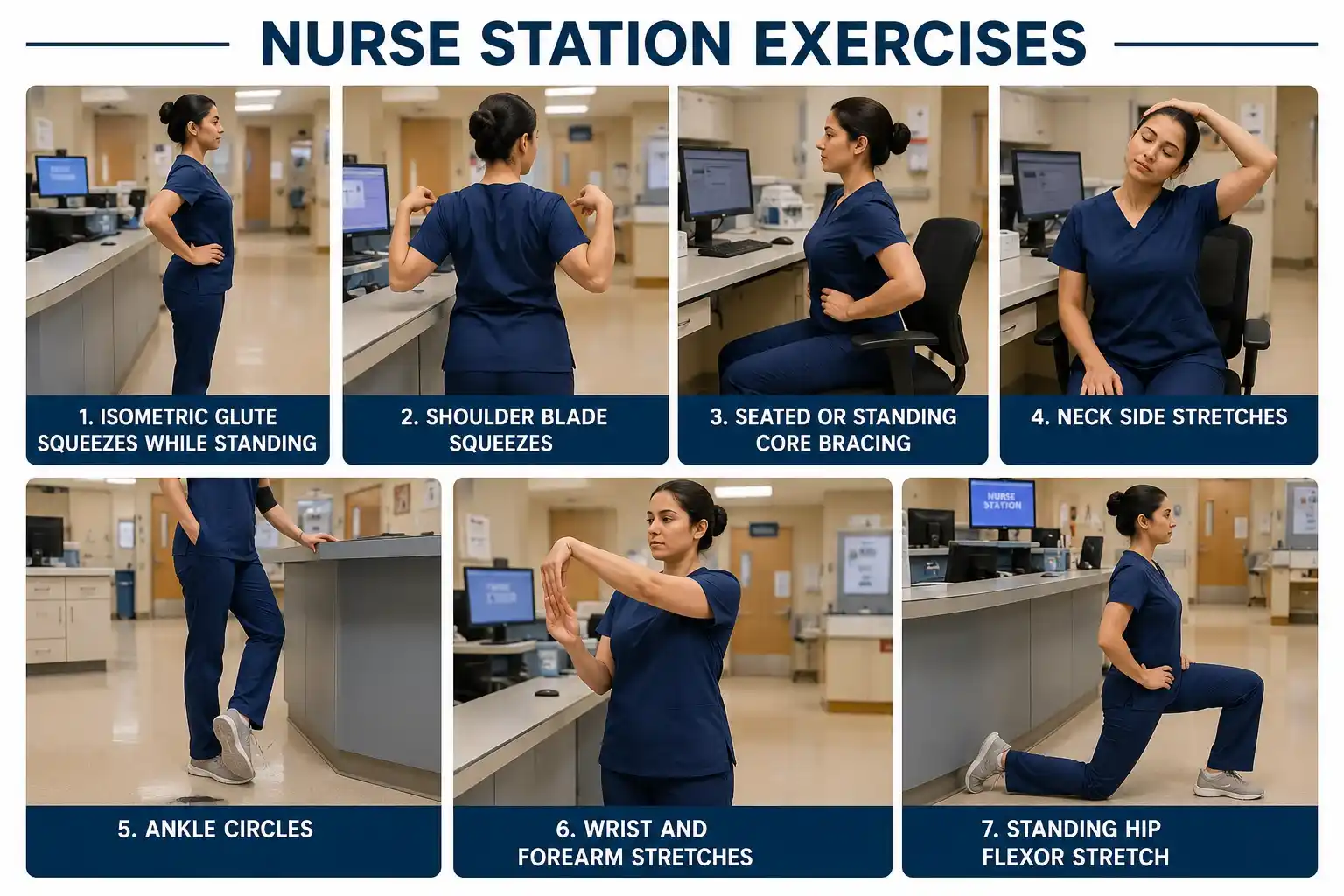
- Isometric glute squeezes while standing (hold for 10 seconds, repeat 10 times).
- Shoulder blade squeezes to counter the forward posture from charting.
- Seated or standing core bracing (breathe in, brace like a punch is coming, hold 10 seconds).
- Neck side stretches at your desk between documentation tasks.
- Ankle circles to improve circulation after prolonged standing.
- Wrist and forearm stretches (essential for nurses who chart constantly).
- Standing hip flexor stretch (lunge position, hold 30 seconds each side).
5-Minute Energy Boost Exercises for Nurses
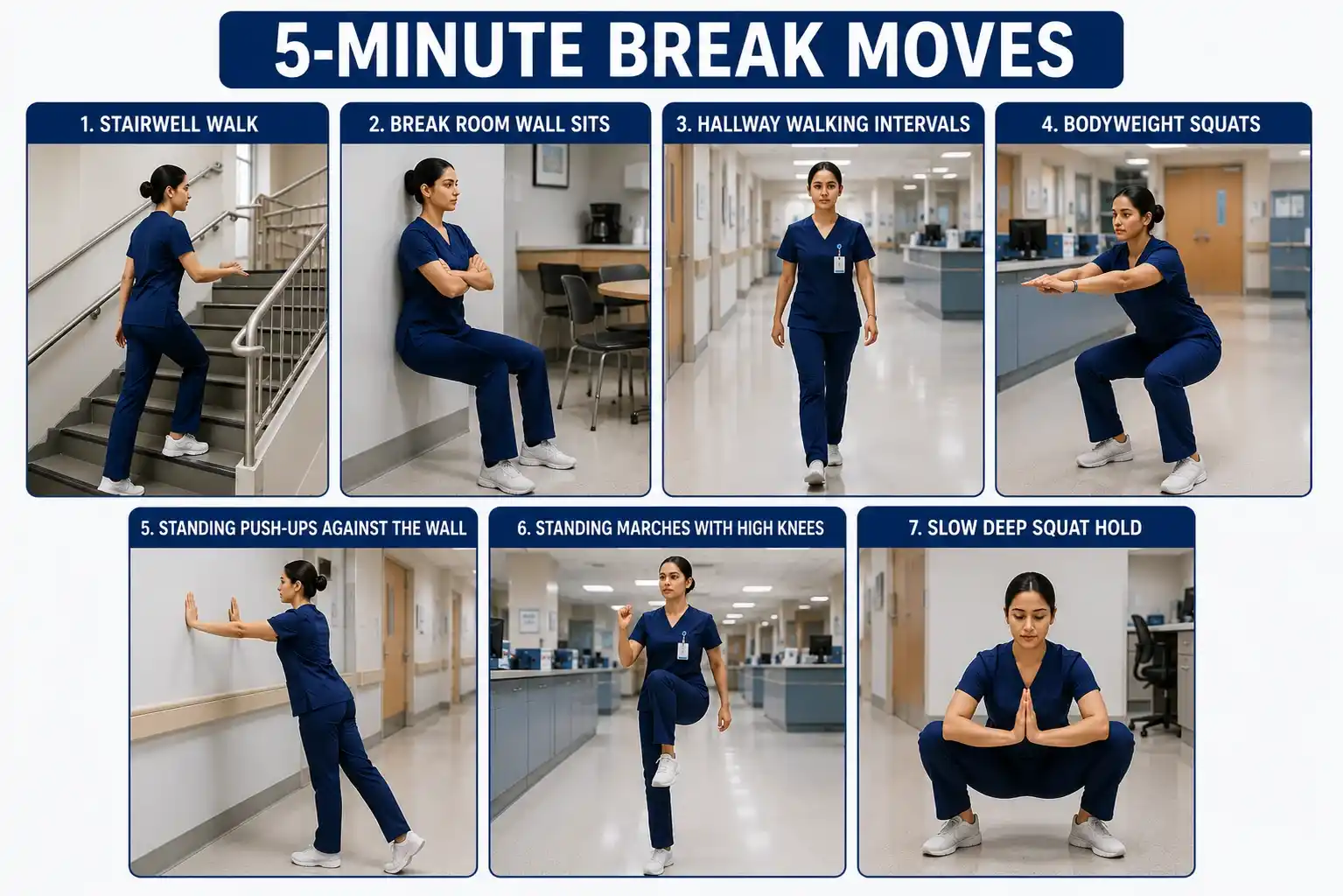
- Stairwell walk: two to three floors, brisk pace, repeat twice.
- Break room wall sits: hold 45 seconds, rest 15 seconds, repeat 4 times.
- Hallway walking intervals: walk normally for 30 seconds, speed-walk for 30 seconds, alternate for five minutes.
- Bodyweight squats: three sets of 15, focusing on full depth if your knees allow.
- Standing push-ups against the wall (shoulder-safe, no floor required).
- Standing marches with high knees to elevate heart rate.
- Slow deep squat hold for 2 minutes to open hips and decompress the spine.
15 to 30-Minute Lunch Break Circuits for Nurses
Circuit A (Strength Focus):
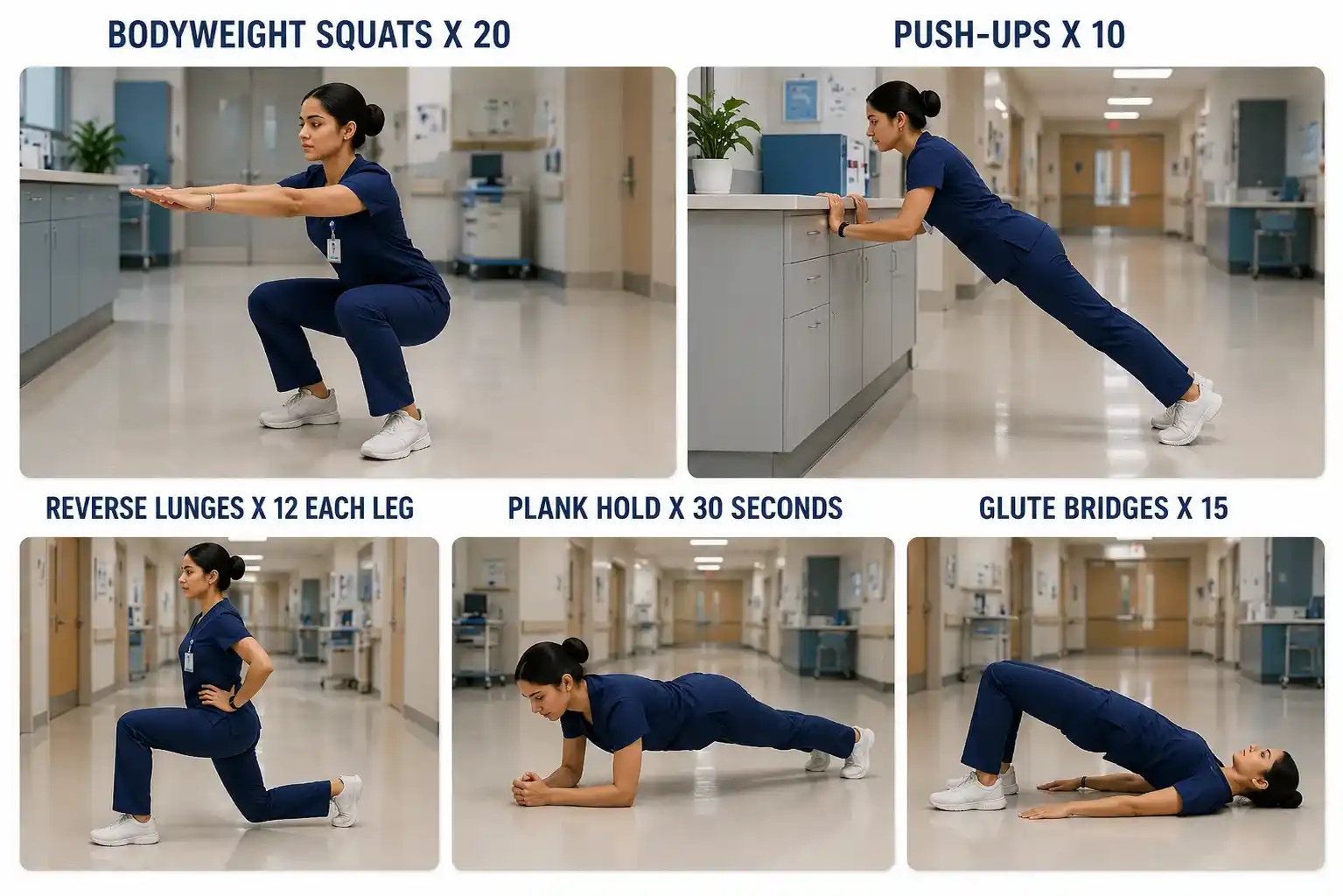
- Bodyweight squats x 20.
- Push-ups x 10 (wall, incline, or floor).
- Reverse lunges x 12 each leg.
- Plank hold x 30 seconds.
- Glute bridges x 15.
- Repeat twice.
Circuit B (Mobility + Tension Relief):
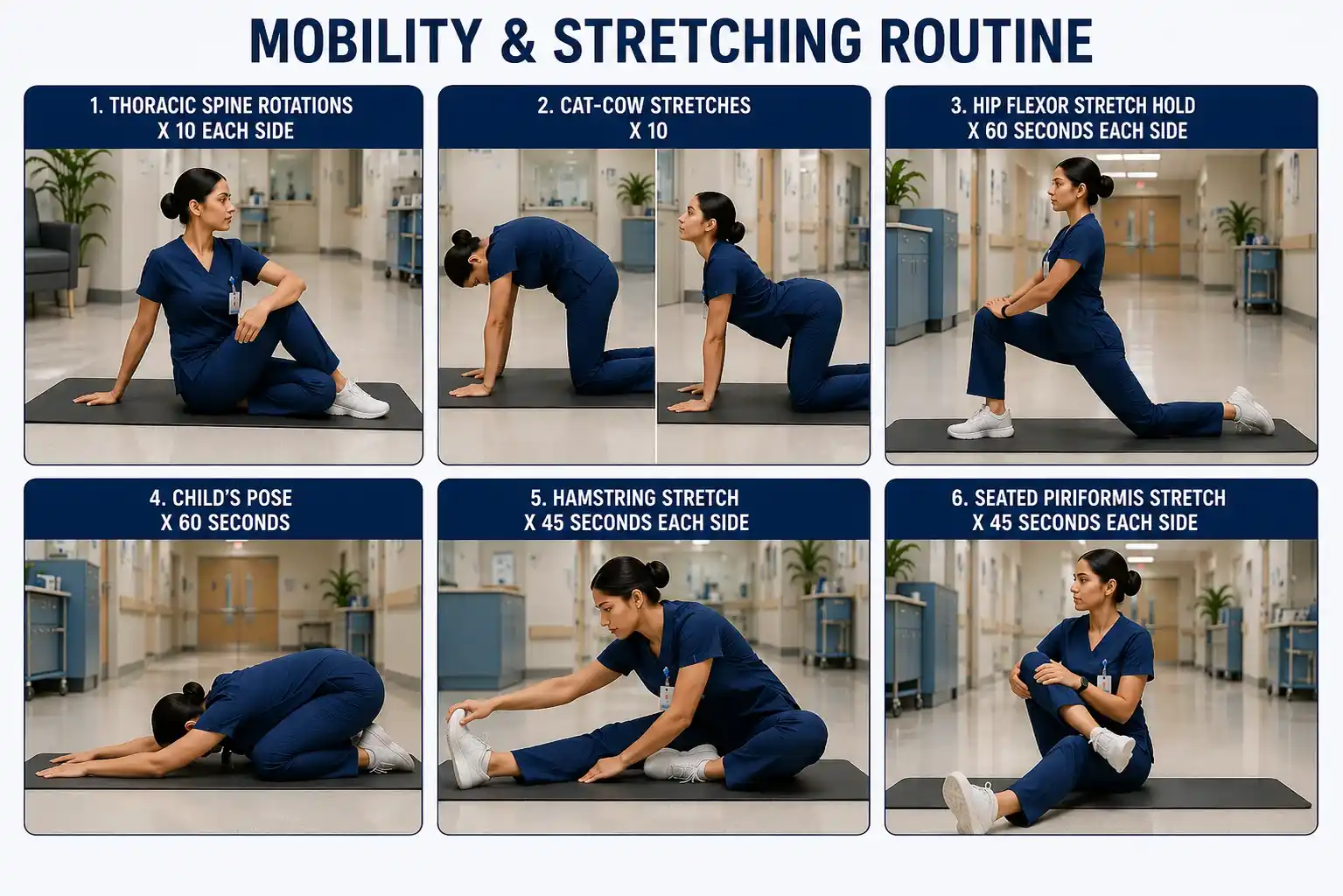
- Thoracic spine rotations x 10 each side.
- Cat-cow stretches x 10.
- Hip flexor stretch hold x 60 seconds each side.
- Child’s pose x 60 seconds.
- Hamstring stretch x 45 seconds each side.
- Seated piriformis stretch x 45 seconds each side.
Circuit C (Cardio Burst):
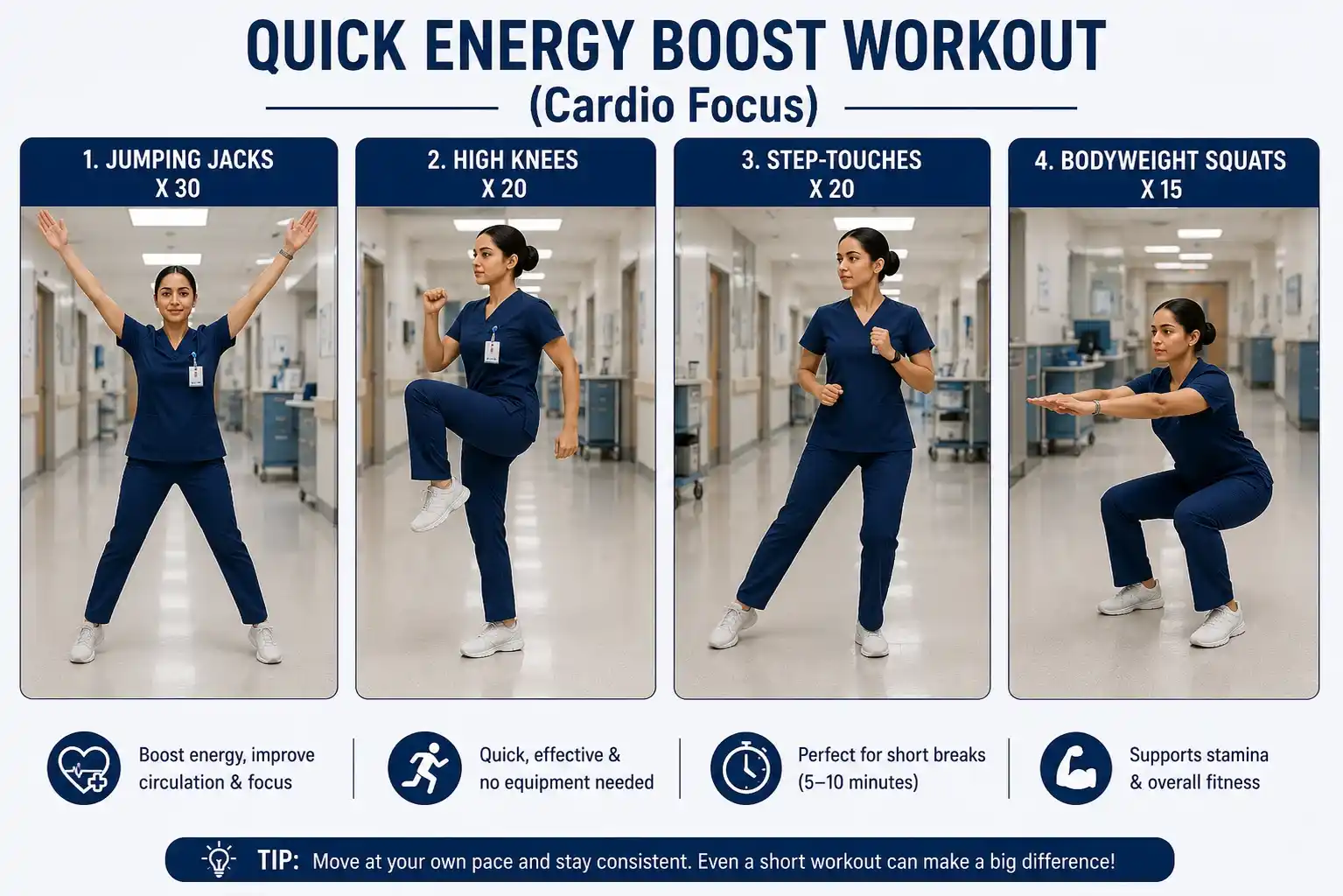
- Jumping jacks x 30.
- High knees x 20.
- Step-touches x 20.
- Bodyweight squats x 15.
- Rest 30 seconds, repeat three times.
Related: Is It Okay to Leave Bedside Nursing?
The 4-Week Nurse Fitness Jump-Start Plan
This plan fits real nursing schedules. It is simple, realistic, and focused on building consistent habits over time.
Week 1: Install the Habit
Your only job this week is to make movement automatic on shift days. No gym required.
- Shift days: Complete three exercise snacks per shift (pick from the 2-minute or 5-minute lists above).
- Off days: Take a 20-minute walk. That is it. Nothing more.
Goal: Movement becomes something you do without thinking, not something you schedule like an appointment
Week 2: Add One Intentional Session
You proved you can move on shift days. Now add one dedicated workout on an off day.
- Shift days: Continue three exercise snacks per shift.
- One-off day: Complete Circuit A or Circuit B (15 to 25 minutes).
- Other off days: Walk 20 to 30 minutes or full rest.
Regular movement after long shifts can make managing stress as a nurse much easier.
Week 3: Build in Recovery
Intensity is not the goal right now. Consistency is. This week focuses on protecting your body on rest days.
- Shift days: Continue exercise snacks, add the thoracic spine and hip flexor stretches at the end of each shift.
- Off days: One workout session, one mobility/stretching day, one full rest day.
- Focus: Sleep and food quality this week. Both directly affect how your body recovers.
Week 4: Assess and Elevate
Look back at the last three weeks. What worked? What felt impossible? Build from what worked.
- Upgrade one session to a 30-minute moderate-intensity workout.
- Add a second dedicated off-day session if your schedule allows.
- Ask yourself: what habit from week one do I want to keep forever?
Pro tip: Put your exercise snack targets in your phone notes or on a sticky note in your locker. When it is written down, it becomes a commitment instead of a good intention.
Related: Toxic Hospital Culture for Nurses
Nutrition Tips for Nurses Around Workouts
Exercise without proper nutrition is only half the equation, and this is something no one talks about in the nurse fitness space.
Before your shift:
- Eat a balanced meal before your shift.
- Avoid sugary foods before work.
- Drink enough water during your shift.
During your shift:
- Keep healthy snacks accessible: Greek yogurt, nuts, boiled eggs, fruit, or protein bars.
- Avoid vending machine meals as your primary fuel.
After your shift:
- Eat protein within 60 minutes after your shift.
- Prioritize sleep if you get fewer than five hours of rest.
For night-shift nurses specifically:
- Avoid heavy meals between midnight and 4 a.m.
- Avoid caffeine after 3 a.m. if you plan to sleep after work.
Long shifts can make meal timing harder. Use our Calorie Calculator to estimate your daily needs and plan better fuel for busy nursing days.
Related: Burnout in Healthcare Jobs
Best Fitness Tools for Busy Nurses
A few tools make it significantly easier to exercise with a busy nursing schedule.
- The Nike Training Club app offers short guided workouts for busy schedules.
- FitOn provides free workouts that work well for nurses with limited time.
- A resistance band, yoga mat, and jump rope can cover most home workouts.
- These tools are affordable, portable, and easy to use at home or work.
- Fitness trackers can help nurses understand their daily movement levels during shifts.
- A simple habit-tracking app called Streaks can help nurses stay consistent with daily movement goals.
When you fall off (and you will at some point):
Do not restart on Monday. Do not restart next month. Restart at your next shift. The biggest mistake nurses make with fitness is treating a skipped week as a reason to start over from scratch. One missed week does not erase what you built. Just pick up where you left off.
Related: What Is the Golden Rule of Bedside Care?
Frequently Asked Questions.
What is an accountability buddy for nurses?
An accountability buddy is a coworker, friend, or fellow nurse who helps you stay consistent with your exercise and wellness goals. This support can be as simple as checking in during shifts, taking short walks together, or encouraging each other to stay active during busy workdays.
Can nurses lose weight with short workouts?
Yes. Nurses can lose weight with short, consistent workouts combined with healthy eating habits. Walking more during shifts and doing bodyweight exercises can burn calories throughout the week.
Can nurses use walking pads at home for exercise?
Yes. Many nurses now use walking pads while watching TV or winding down after shifts. These compact treadmills fit small apartments and require very little setup. Walking pads make it easier to stay active without going to the gym.
What Are Silent Workouts for Nurses?
Silent workouts are low-noise exercises designed for nurses who live with family or roommates and get home late at night. Resistance bands, yoga flows, mobility stretches, and walking pads are common options. These workouts help nurses stay active without disturbing others after overnight shifts.
What Is Hospital Compression Wear for Nurse Recovery?
Hospital compression wear includes items like compression socks and recovery leggings designed to improve circulation and reduce leg fatigue during long nursing shifts. Many nurses use compression gear to help with soreness, swelling, and recovery after spending hours on their feet.
A Final Word on Mindset
A 10-minute workout you actually complete is far more effective than a one-hour routine you keep postponing. Three short stretch sessions every week can do more for your health than an intense gym plan you abandon after two weeks.
The nurses who succeed with fitness are not always the most disciplined. They are the ones who learn How Nurses Can Exercise with a Busy Work Schedule by adapting workouts to real hospital life instead of waiting for perfect conditions.
As a nurse, you spend your career caring for everyone else’s health. Your own body deserves at least a few minutes of movement, recovery, and care during the week. A simple exercise for nurses is not selfish. It is one of the best ways to protect your energy, health, and long-term career.
Start small. Stay consistent. Build from there.
Have questions about building a sustainable fitness routine around shift work? Drop a comment below or reach out directly. And if this helped you, share it with a colleague who needs it.
References
- Harvard Nurses’ Health Study
- Bureau of Labor Statistics – Occupational Injuries by Industry
- British Journal of Sports Medicine – Exercise Snacking Research
- National Institute for Occupational Safety and Health – Healthcare Worker Safety
- https://www.cdc.gov/niosh/healthcare/
Disclaimer: This content is for informational purposes only and is not medical or professional health advice.
Are you a healthcare expert, fitness coach, nurse, or wellness writer? Visit our Write for Us page and share your insights with readers who truly need practical health advice.