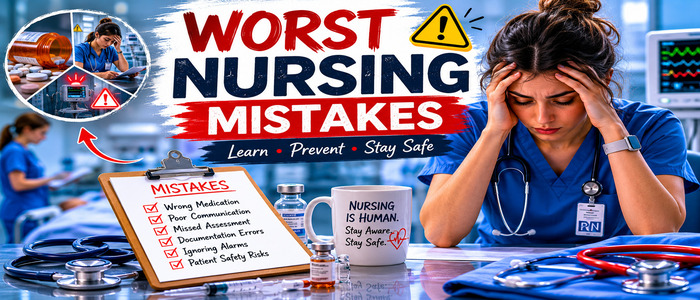
10 Worst Nursing Mistakes That Can Put Patients at Risk
The worst nursing mistakes can compromise patient safety and quality of care. Common examples include medication errors, missed signs of a patient’s worsening condition, and incomplete or inaccurate handoff communication. Poor documentation, incorrect patient identification, and missed follow-up on abnormal findings can also compromise patient safety.
Understanding these mistakes matters because nurses directly monitor patients, administer treatments, communicate changes, and follow safety procedures. A preventable error can affect patient care and may also lead to professional consequences for the nurse.
This article explains common nursing mistakes, why they happen, and how nurses can prevent them. You’ll also learn how to recognize potential errors, respond appropriately when a mistake occurs, and use safer practices in everyday clinical care.
10 Worst Nursing Mistakes That Can Put Patients at Risk
Nursing errors can happen at different stages of care, from preparing medications to coordinating tasks with other healthcare professionals. The following 10 mistakes focus on situations nurses may encounter in clinical practice, the factors that contribute to them, and steps that can help reduce preventable errors.
1. Making Medication Errors
Medication errors can occur during prescribing, dispensing, preparation, administration, or monitoring. Nurses help ensure medications are given correctly by verifying orders, checking patient identity, and monitoring patient responses.
What Can Go Wrong?
Giving the wrong medication, dose, or route can cause an adverse drug event. The consequences depend on the medication, the amount given, and the patient’s health. Some errors cause little harm, while others can lead to severe reactions, complications, or the need for emergency treatment.
For example, administering a medication intended for a different patient or giving a dose that exceeds the prescribed amount can put the patient at risk. Skipping required monitoring may also delay recognition of an adverse reaction.
Why Does It Happen?
Medication errors can happen for several reasons, including:
- Interruptions during medication preparation or administration
- Confusing medication names or unclear orders
- Dose calculation mistakes
- Incorrect patient identification
- Heavy workloads and time pressure
- Lack of familiarity with a medication
Assuming that a medication is correct because it appears on a list is not a substitute for checking the current order and relevant safety requirements.
Preventing Medication Errors
Nurses can reduce medication-related risks by following these practices:
- Verify the medication order, dose, route, timing, and relevant patient-specific instructions before administration.
- Confirm the patient’s identity using the facility’s approved identifiers.
- Check allergies, relevant contraindications, and required assessments or monitoring.
- Use an approved medication reference or seek clarification when an order is unclear.
- Follow facility procedures for high-alert medications and independent double-checks when required.
- Document administration accurately and monitor the patient for the intended response and possible adverse effects.
If a medication error occurs, assess the patient promptly, notify the appropriate clinician, and follow the facility’s reporting and treatment procedures. Do not delay urgent care while completing an incident report.
2. Missing Signs of a Patient’s Worsening Condition
Recognizing changes in a patient’s condition is a core nursing responsibility. A patient may deteriorate gradually or develop sudden warning signs that require quick assessment and intervention.
What Can Go Wrong?
Missing a significant change can delay medical evaluation and treatment. Depending on the patient’s condition, deterioration may lead to serious complications, such as:
- Respiratory failure
- Severe infection
- Shock
- Other medical emergencies
For example, a patient who becomes confused, has increasing breathing difficulty, falling blood pressure, or a significant change in oxygen saturation may need urgent assessment. Failing to consider all symptoms together can delay timely treatment.
The Royal College of Physicians’ NEWS2 guidance explains how vital signs help healthcare professionals assess acute illness and identify patients who may need a faster clinical response.
Why Does It Happen?
Nurses may miss signs of deterioration because of:
- Slight changes in a patient’s condition
- Frequent interruptions during patient care
- Incomplete assessments
- Assuming the patient is stable
- Failing to compare current findings with previous observations
You may miss important symptoms if you rely only on vital signs instead of assessing the patient’s overall condition.
Recognizing and Responding to Changes
- Monitor vital signs and other findings according to the patient’s condition and care plan.
- Compare new findings with previous assessments to identify meaningful changes.
- Take new symptoms seriously, even when a single measurement appears normal.
- Repeat assessments when findings are unexpected or the patient’s condition changes.
- Use the facility’s early warning score and escalation procedures when applicable.
- Report urgent concerns and communicate the specific findings that support them.
If a patient appears acutely unwell, do not wait for a score to reach a particular threshold before seeking help. Follow emergency procedures and use clinical judgment within your scope of practice.
3. Making Patient Identification Errors
Correct patient identification helps ensure that medications, procedures, tests, and treatments reach the intended person. You should never identify a patient based on:
- Familiarity with the patient
- Room number
- Bed location
What Can Go Wrong?
An identification error can result in the wrong patient receiving medication, undergoing a procedure, or having a specimen collected under someone else’s name. These errors can delay the correct patient’s care and expose another person to unnecessary risks.
For example, skipping identity checks can lead to errors when two patients have similar names.
Why Does It Happen?
Common causes of patient identification errors include:
- Similar patient names
- Mislabeled specimens
- Assumptions based on room location
- Skipped identity checks during busy shifts
Identification can also be less reliable when staff follow inconsistent procedures or when a patient’s wristband information does not match the medical record.
Steps for Accurate Patient Identification
- Use at least two approved patient identifiers per facility policy.
- Confirm that the identifiers match the medical record, order, medication, or specimen label.
- Ask the patient to state their name and other identifying details rather than asking leading questions.
- Verify identity before medications, specimen collection, procedures, and other relevant care.
- Resolve any discrepancies before proceeding, unless emergency protocols require immediate action.
4. Poor Handoff Communication
Handoff communication transfers responsibility for a patient’s care from one healthcare professional to another. It commonly occurs during shift changes, transfers between units, and changes in the clinician responsible for treatment.
What Can Go Wrong?
Incomplete handoffs can leave the next nurse unaware of important information, such as:
- Changes in the patient’s symptoms or condition
- Pending test results
- Medication changes
- Required follow-up care
These gaps can delay treatment or cause important tasks to be missed.
For example, if a nurse does not communicate that a patient’s blood pressure has been trending downward, the incoming nurse may not recognize the significance of a further decline.
Why Does It Happen?
Handoffs may be rushed or interrupted. Nurses may also rely on memory instead of a structured process or assume the incoming clinician has already reviewed the medical record. Unclear responsibility for pending results or follow-up tasks can create additional gaps in care.
Improving Handoff Communication
- Use the facility’s approved handoff method, such as SBAR (Situation, Background, Assessment, and Recommendation).
- Communicate current concerns, relevant changes, allergies, treatment plans, and pending tasks.
- Clearly identify which actions still need to be completed and who is responsible for them.
- Allow questions and clarify information that could affect patient care.
- Protect handoff time from avoidable interruptions whenever possible.
- Use read-back or confirmation techniques for critical information when appropriate.
A good handoff is not a summary of the shift. It gives the next clinician the information needed to continue care safely.
5. Errors in Nursing Brain Sheets
Brain sheets help nurses organize patient information and track care tasks during a shift. However, errors or missing details can make it harder to monitor patient needs and remember required follow-up.
What Can Go Wrong?
Errors in a brain sheet can cause nurses to overlook important information or forget pending tasks. For example, a nurse may write down an abnormal vital sign but forget to note that it needs reassessment. If the finding is not followed up, a change in the patient’s condition may go unnoticed.
Why Does It Happen?
Brain sheet errors can occur because of:
- Incorrect vital signs or patient details
- Failure to update notes when a patient’s condition changes
- Unclear abbreviations or handwriting
- Forgetting to check pending tasks
Keeping Brain Sheets Accurate
- Verify patient information before recording it.
- Keep notes clear, brief, and organized.
- Update the brain sheet when the patient’s condition or care needs change.
- Mark pending tasks and review them throughout the shift.
- Confirm important details against the official medical record.
- Document assessments, interventions, and patient responses in the approved medical record according to facility policy.
A brain sheet is a temporary organizational aid, not a substitute for official nursing documentation.
6. Ignoring Infection Prevention Practices
Infection prevention measures reduce opportunities for harmful microorganisms to spread between patients, healthcare workers, equipment, and the care environment. Hand hygiene, appropriate personal protective equipment (PPE), and safe device handling are central parts of these precautions.
What Can Go Wrong?
Poor infection prevention practices can increase the risk of healthcare-associated infections. Depending on the patient’s condition, these infections may lead to additional treatment, longer hospitalization, serious complications, or other adverse outcomes. Incorrect handling of an intravenous line or urinary catheter can also compromise infection prevention.
The CDC’s hand hygiene guidance for healthcare settings outlines recommended practices for reducing infection transmission.
Why Does It Happen?
Factors that can contribute to infection prevention failures include:
- Limited access to hand hygiene supplies
- Incorrect use of PPE
- Inconsistent adherence to infection prevention protocols
Staff may also overlook precautions when a task seems brief or when they move quickly between patients.
Following Safe Infection Prevention Practices
- Perform hand hygiene at the recommended moments during patient care.
- Use PPE appropriate to the anticipated exposure and required precautions.
- Follow aseptic technique during procedures that require it.
- Handle and maintain invasive devices according to established protocols.
- Clean and disinfect equipment according to facility requirements.
- Follow isolation precautions and report potential infection-control breaches.
If a breach occurs, take immediate steps to reduce exposure and follow the facility’s reporting and response procedures.
7. Failing to Prevent Patient Falls
Patient falls are a significant safety concern, particularly for people with impaired mobility, confusion, dizziness, weakness, or medication-related effects. Nurses help identify individual risks and plan precautions that match each patient’s needs.
What Can Go Wrong?
A fall can cause bruises, fractures, head injuries, or fear of moving around. Some patients experience serious complications, particularly older adults or those with conditions that increase the risk of injury.
For example, a patient who becomes dizzy after standing may need assistance with transfers and walking. If staff fail to recognize or communicate this risk, the patient may try to walk without assistance and fall.
Why Does It Happen?
Common factors that increase fall risk include:
- Incomplete fall-risk assessments
- Lack of assistance with walking or transfers
- Cluttered or unsafe surroundings
- Limited awareness of mobility limitations
- Medication changes that affect alertness or balance
- Changes in cognition, strength, or balance
A precaution that worked earlier in the shift may no longer be sufficient if the patient’s condition changes.
Reducing Patient Fall Risks
- Assess fall risk using the facility’s approved approach and reassess when clinically indicated.
- Match precautions to the patient’s mobility, cognition, medications, and current condition.
- Keep call bells and necessary items within reach.
- Maintain clear pathways and use appropriate lighting.
- Assist with transfers and walking when needed.
- Communicate mobility limitations and fall precautions during handoffs.
- Follow individualized plans for alarms, footwear, mobility aids, and supervision where indicated.
Fall prevention should help patients move safely without unnecessarily limiting their activity. The goal is to help patients move as safely and independently as their condition allows.
8. Delaying Reporting or Asking for Help
Recognize when a patient’s needs exceed what can safely be managed without additional assistance. Prompt escalation helps the healthcare team respond to urgent changes before the situation becomes more serious.
What Can Go Wrong?
Delaying escalation can postpone assessment, treatment, or emergency intervention. A patient with new chest pain, severe breathing difficulty, a sudden change in consciousness, or other acute warning signs may deteriorate while staff wait for the situation to become clearer.
For example, a nurse who notices a significant change in a patient’s condition but delays contacting the appropriate clinician may lose valuable time that could have been used to assess and treat the problem.
Why Does It Happen?
Inexperience, self-doubt, fear of criticism, unclear reporting pathways, or difficulty reaching the responsible clinician may contribute to delayed reporting.
Some nurses may also hesitate because raising a concern has previously led to changes in treatment. However, a new or worsening finding still deserves appropriate assessment.
When and How to Seek Help
- Recognize warning signs and follow the facility’s escalation criteria.
- Report concerns quickly using clear, specific clinical findings.
- Use structured communication, such as SBAR, when appropriate.
- State clearly when you believe the patient is deteriorating or needs urgent review.
- If the concern remains unresolved, follow the chain of escalation or rapid response process.
- Seek assistance when a task or clinical decision exceeds your competence or authority.
If the patient appears to be experiencing an emergency, activate the appropriate emergency response instead of waiting for a routine callback.
9. Working While Excessively Fatigued
Nursing often involves long shifts, night work, rotating schedules, and sustained attention to complex patient needs. Excessive fatigue can impair alertness and cognitive performance, making it harder to respond quickly to changing situations.
What Can Go Wrong?
Fatigue may lead to:
- Reduced attention
- Slower reaction times
- Difficulty making decisions
These effects can increase the risk of errors during medication administration, documentation, handoffs, and other clinical tasks.
For example, a severely fatigued nurse may have more difficulty noticing a discrepancy in a medication order or remembering a task that still requires follow-up.
The NIOSH guidance on long work hours and extended shifts discusses fatigue-related risks and strategies for nurses and healthcare organizations.
Why Does It Happen?
Factors that can contribute to nursing fatigue include:
- Long shifts
- Inadequate rest between shifts
- Consecutive demanding shifts
- Insufficient sleep
- Heavy workloads and missed breaks
You may get used to working while tired without realizing that fatigue is affecting your alertness.
Reducing Fatigue-Related Risks
- Protect sleep and recovery time as much as scheduling and personal circumstances allow.
- Use available breaks to rest and recover during demanding shifts.
- Recognize signs such as difficulty concentrating, repeated mistakes, or unusual drowsiness.
- Report fatigue-related safety concerns to the appropriate supervisor.
- Follow facility procedures for obtaining assistance or reassignment when fitness for duty is in question.
- Support staffing and scheduling practices that reduce avoidable fatigue.
Individual strategies can help, but fatigue is also an organizational safety concern. Nurses should not be expected to manage unsafe workloads through personal coping strategies alone.
10. Delegating Tasks Without Proper Follow-Up
Delegation allows nursing teams to distribute appropriate tasks while maintaining safe patient care. Delegate a task only when it matches the patient’s condition, the task requirements, and the team member’s skills and authorized role.
What Can Go Wrong?
Inappropriate delegation or inadequate follow-up can lead to missed care, delayed reporting, or failure to recognize a change in the patient’s condition.
For example, a nurse may ask an assistive staff member to obtain vital signs but fail to review the results or establish what should happen if a reading is abnormal. The information may be collected without the necessary clinical response.
The NCSBN’s guidelines on nursing delegation outline key principles for assigning nursing tasks.
Why Does It Happen?
Problems may arise when instructions are vague, responsibilities are unclear, or a task is assigned without considering the staff member’s training and authorized role. Heavy workloads can also make it difficult for nurses to complete necessary follow-up.
Delegation may fail when the nurse assumes the task is completed correctly without confirming the result or reviewing unexpected findings.
Delegating Tasks Safely
- Assess the patient’s condition and determine whether the task is appropriate to delegate.
- Consider the task’s complexity, the patient’s stability, and the team member’s competence and authorized scope.
- Give clear instructions about what to do, when to report findings, and which changes require immediate attention.
- Confirm that the team member understands the assignment.
- Review results and follow up on tasks according to the patient’s needs.
- Remain accountable for the nursing responsibilities that cannot be delegated under applicable rules and policies.
Safe delegation is more than assigning a task. It requires clear communication, appropriate supervision, and follow-up to make sure the patient’s needs are met.
What Causes Nursing Mistakes? System Failures vs. Individual Errors
Nursing mistakes do not always result from an individual nurse’s actions. Heavy workloads, inadequate staffing, interruptions, and unclear procedures can make safe patient care more difficult. Recognizing both types of problems helps hospitals address safety risks without blaming nurses for every mistake.
| System-Level Problems | Individual Errors |
|---|---|
| Inadequate staffing and unsafe workloads | Missing important patient details |
| Unclear or inconsistent hospital procedures | Skipping required safety checks |
| Poorly designed electronic health record workflows | Entering incorrect information into the medical record |
| Frequent interruptions and limited support | Misreading medication instructions |
| Ineffective handoff systems | Failing to communicate a significant change in a patient’s condition |
These factors can overlap. For example, heavy workloads and frequent interruptions may contribute to an individual mistake, while clear procedures, adequate staffing, and effective safety checks can help reduce risks. Healthcare organizations should address staffing, workflow, training, and communication problems that contribute to preventable errors.
You may also read: Toxic Hospital Culture for Nurses
What Should a Nurse Do After Making a Mistake?
Mistakes can happen in nursing, even with precautions. What matters is how you respond, communicate with the care team, and follow the appropriate safety procedures.
- Protect the Patient First: Assess the patient’s condition and take immediate action to reduce harm.
- Notify the Appropriate Clinician: Report the error promptly to the responsible clinician or supervisor so the patient receives appropriate care.
- Report the Error: Follow facility policy to report the incident and support patient safety reviews.
- Accurate Documentation: Record the facts, care provided, and patient response accurately in the official medical record.
- Learn From the Mistake: Identify what contributed to the error and take steps to prevent similar incidents in the future.
Reporting a mistake feels terrifying. But the steps you take in the next hour matter more than the mistake itself. Here is exactly what to do.
7 Reasons Nurses Can Lose Their License
A minor, isolated mistake does not automatically mean a nurse will lose their license. The outcome depends on the seriousness of the conduct, potential or actual patient harm, relevant regulations, and the circumstances of the case.
- Serious or Repeated Patient Care Errors: Repeated or serious mistakes, such as giving the wrong medication, missing critical lab results, failing to assess a patient, or providing an unsafe handoff, may lead to disciplinary action when patient safety is compromised.
- Practicing Beyond Your Scope: Performing procedures without proper training, diagnosing beyond your legal scope, or failing to obtain required supervision can lead to disciplinary action against a nursing license.
- Impairment and Drug Diversion: Working while impaired by alcohol or drugs, diverting controlled substances, or failing to account for controlled medications can trigger investigations and license discipline.
- HIPAA and Patient Privacy Violations: Improperly sharing confidential patient information, including identifiable details on social media, can result in serious professional consequences.
- Criminal Convictions and Failure to Report: Certain criminal offenses, such as DUI, theft, or assault, may affect a nursing license. Failing to report required arrests, charges, or convictions can create additional disciplinary problems.
- Failure to Meet Licensing Requirements: Allowing a license to expire, failing to complete required continuing education, or practicing without an active license can lead to disciplinary action.
- Professional Misconduct, Fraud, and Dishonesty: Falsifying patient records, documenting care that was never provided, misrepresenting credentials, violating patient boundaries, or engaging in serious professional misconduct may result in suspension or revocation.
Can a Nursing Mistake Lead to Criminal Charges?
Yes, a nurse can face criminal charges and possible imprisonment for a serious medical error if the conduct meets the legal requirements for a crime. However, not every nursing mistake is a criminal offense.
In the RaDonda Vaught case, a jury convicted the former Tennessee nurse of criminally negligent homicide and gross neglect of an impaired adult after a fatal medication error in 2017. In May 2022, she received three years of supervised probation with judicial diversion instead of a prison sentence. She also lost her nursing license and was fired.
The case shows that serious errors can have criminal and professional consequences, but the outcome depends on the circumstances and applicable laws.
Frequently Asked Questions
Can electronic prescription systems significantly reduce medication errors?
Yes. Electronic prescription systems can reduce medication errors, including common prescribing errors caused by illegible handwriting, incomplete prescriptions, and incorrect doses. A 2022 systematic review found that most included studies reported fewer prescribing errors after electronic prescribing was introduced. However, these systems do not eliminate all medication errors, and their effectiveness depends on system design, clinical decision support, and implementation.
Why do nurses not report medication errors?
Nurses may hesitate to report medication errors because they fear blame, punishment, job loss, legal consequences, or being viewed as incompetent. Other barriers include heavy workloads, time-consuming reporting procedures, lack of feedback from management, unclear reporting guidelines, and a workplace culture that discourages speaking up.
What should I do when a supervisor pressures me to perform a task I am not competent to do?
Politely but firmly explain that you lack the necessary skills or knowledge to perform the task safely. Do not accept a delegated task if you cannot carry it out competently or if it could compromise patient safety. Ask a senior staff member for guidance, clarification, or appropriate supervision, and request training if needed. Patient safety should come before pressure to accept a task.
What are some of the most common mistakes that new nurses make?
New nurses commonly make medication errors, overlook infection prevention practices, and make mistakes in patient documentation. Other common errors include contacting a physician without having the necessary patient information ready and failing to take adequate precautions to prevent patient falls. Inexperience, heavy workloads, and pressure during long shifts can increase the risk of these mistakes.
As a new nurse, how do I forgive myself for mistakes made at work?
Start by taking responsibility for the mistake and giving yourself time to process what happened. Talk with a trusted colleague or mentor instead of letting shame build in silence. Once you feel ready, reflect on what contributed to the error and identify practical steps to prevent it from happening again, such as seeking additional training, following safety procedures, and double-checking your work. Learn from the experience without allowing one mistake to define your worth as a nurse.
Why might nurses conceal a colleague’s mistake that also affects them?
Nurses may conceal a colleague’s mistake because they fear damaging professional relationships, losing friendships, facing retaliation, or being blamed by coworkers or managers. Some also worry that reporting an error could lead to unfair punishment or a heavier workload.
References
- Centers for Disease Control and Prevention. (n.d.). Clinical safety: Hand hygiene in healthcare settings. https://www.cdc.gov/clean-hands/hcp/clinical-safety/index.html
- National Council of State Boards of Nursing. (2006). A position paper on the role of the nurse in the delegation of nursing care. https://www.ncsbn.org/public-files/NGND-PosPaper_06.pdf
- National Institute for Occupational Safety and Health. (n.d.). Work hour training for nurses. Centers for Disease Control and Prevention. https://www.cdc.gov/niosh/work-hour-training-for-nurses/
- NurseJournal Staff. (n.d.). RaDonda Vaught medical errors: What nurses can do. NurseJournal. https://nursejournal.org/articles/radonda-vaught-medical-errors-what-nurses-can-do/
- Royal College of Physicians. (n.d.). National Early Warning Score (NEWS) 2. https://www.rcp.ac.uk/improving-care/resources/national-early-warning-score-news-2/
- Osmani, F., et al. (2023). Evaluation of the effectiveness of electronic prescription in reducing medical and medication errors: A systematic review study. Annales Pharmaceutiques Françaises, 81(3), 433–445. https://doi.org/10.1016/j.pharma.2022.12.002
- Namadi, F., Alilu, L., & Habibzadeh, H. (2024). Nurses’ experiences of reporting the medical errors of their colleagues: A qualitative study. BMC Nursing, 23, 415. https://doi.org/10.1186/s12912-024-02092-8
- Royal College of Nursing. (2018, September 7). Knowing when to say no. https://www.rcn.org.uk/magazines/Nsws/2018/Knowing-when-to-say-no
About the Author
John Watson founded StressHealed, a platform dedicated to evidence-based content on stress, wellbeing, and healthcare for nurses and frontline medical workers. John researches and writes about the healthcare system, from clinical workflows to workforce burnout, with content grounded in peer-reviewed studies, industry reports, and insights gathered directly from healthcare professionals.
Connect: stresshealed.com
Disclaimer: This article is for educational purposes only and does not replace professional nursing training, clinical judgment, or workplace policies. Always follow current clinical guidelines and patient safety protocols.