12-Hour Night Shift Meal Plan for Weight Loss: A Guide for Nurses and Healthcare Workers
Losing weight on the night shift is possible, but it usually requires more structure than a daytime routine. A practical 12-hour night-shift meal plan for weight loss works by timing smaller meals and planned snacks around your shift clock, not just the wall clock. The goal is to build consistency, protect your sleep, and reduce random 3 a.m. food choices that make night shift weight loss harder.
Introduction
If you work nights, you already know food gets complicated after midnight. A salad can sound good before the shift, but by 3 a.m., the vending machine, leftover pizza, or sugary coffee may feel more realistic. You are not the only one dealing with that. Nurses and healthcare workers need meals that survive missed breaks, tired feet, and unpredictable patient care.
A 12-hour night-shift meal plan for weight loss helps nurses and healthcare workers plan around shift life, with a solid pre-shift meal, practical snacks, lighter overnight choices, and sleep-friendly eating after work.
In this guide, you’ll learn how night-shift nurses can understand calorie needs, create a safe calorie deficit, and make smarter food choices during long shifts.
You’ll also see how stress, sleep, meal timing, and simple planning can support weight loss without extreme dieting.
Why Losing Weight on Night Shift Feels Harder Than It Should
If you have gained weight since moving to nights, even though you feel like you are “eating the same as before,” you are not imagining it. Night work can disrupt your circadian rhythm.
Here is what may happen during the night shift:
- Your digestive system, insulin response, and hunger hormones follow a roughly 24-hour internal clock. That internal clock usually expects you to eat during the day and sleep at night.
- When you eat your largest meals between midnight and 6 a.m., your body may not process that food as efficiently.
- Shift workers have higher documented risks of obesity, type 2 diabetes, and gastrointestinal symptoms than day workers.
- Eating at night does not automatically cause weight gain. Weight gain happens when you consistently eat more calories than your body uses.
- Night eating can still make weight gain more likely because fatigue can lead to large portions, high-calorie snacks, sugary-caffeine drinks, and less sleep.
Why This Matters
Night-shift eating is not a rare problem. According to the Bureau of Labor Statistics, about 16% of U.S. wage and salary workers work non-daytime schedules, and about 4% work a regular night shift.
Obesity is also common among U.S. adults. According to the CDC’s National Center for Health Statistics, 40.3% of U.S. adults had obesity from August 2021 to August 2023.
Stress, “Stress Belly,” and Mindless Eating on the Unit
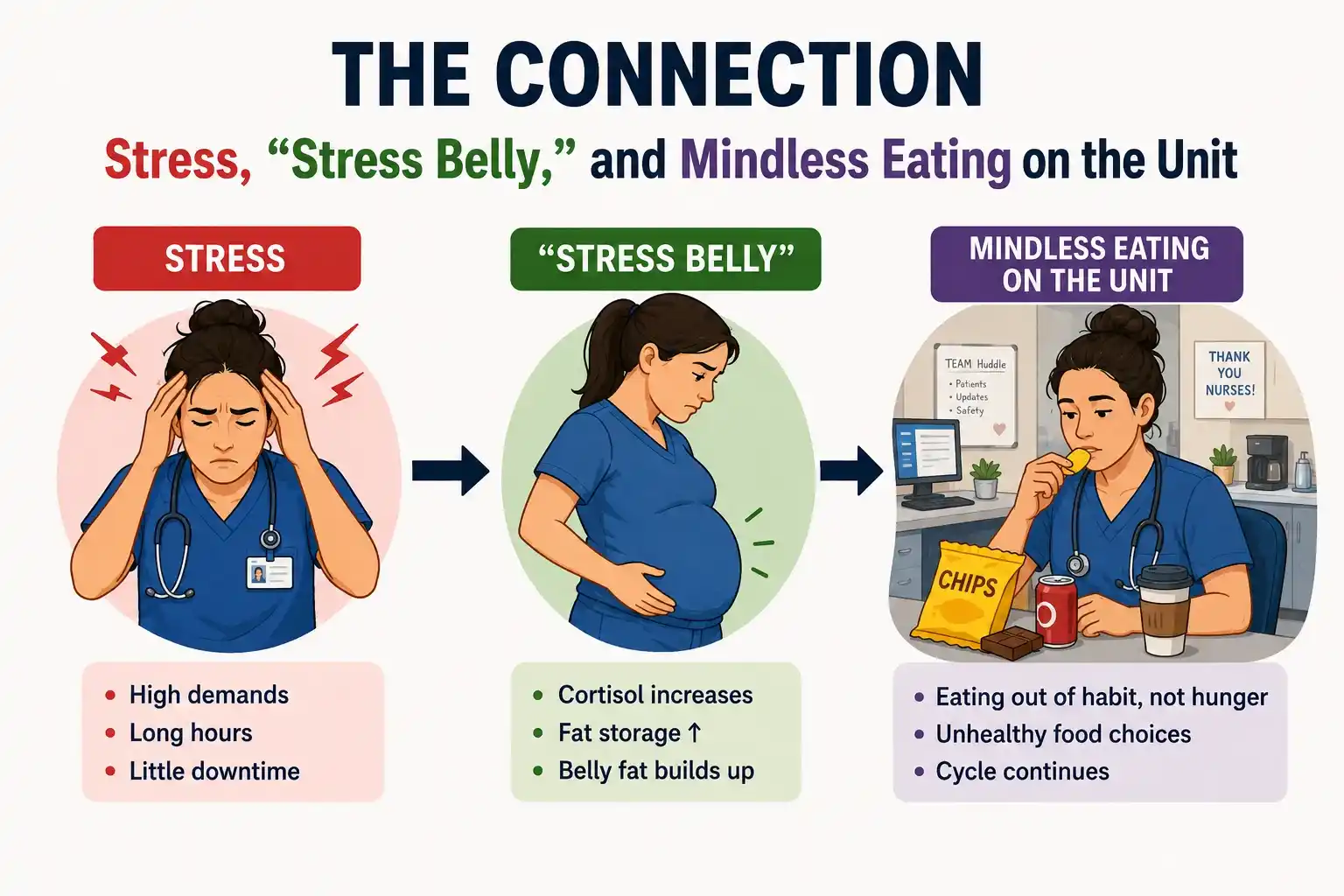
Chronic stress can raise cortisol, and higher cortisol can increase insulin production. This may lower blood sugar and trigger cravings for fatty or sugary foods, a pattern Cleveland Clinic has linked to long-term weight gain and abdominal fat storage, sometimes called stress belly.
Stress can raise obesity risk for anyone, but 12-hour nursing shifts can make it harder to manage because of short staffing, missed breaks, and nonstop patient demands.
This is where mindless eating often happens, like break-room candy, leftover crackers, or eating at the nurses’ station without noticing. Mindless eating means eating without paying full attention to what, why, or how much you are eating.
Use our stress level checker to understand your stress patterns before they affect your sleep, cravings, and night-shift weight loss goals.
The Core Rules of a Night Shift Meal Plan for Nurses
There is no single best diet for shift workers that supports every unit, every body, and every commute. But research on shift work nutrition points to a consistent short list of rules that apply whether you are an ICU nurse, an ER nurse, a med-surg nurse, or a CNA. Use these as the foundation of any night shift diet plan:
- Anchor your meals to your shift, not the clock. This is the same core principle behind AM vs PM nutrition: your “big meal” should happen before or early in your shift, when your body can still handle food efficiently.
- Keep food on shift smaller and lighter. Heavy, greasy meals at 2 a.m. tend to sit like a brick and may leave you sleepier instead of more alert.
- Treat your post-shift meal as a sleep-prep meal, not a reward meal. What you eat at 7 a.m. should help you fall asleep, not keep you wired.
- Build in protein and fiber at every eating point. This is the single biggest lever for staying full during a long shift, according to NIOSH’s diet guidance for night-shift nurses.
- Cut caffeine off with enough runway before bed. The Food and Drug Administration notes that most healthy adults can safely have up to 400 milligrams of caffeine a day, about two to three 12-ounce cups of coffee, but timing matters as much as total amount.
Prioritize sleep as part of the plan. Poor sleep disrupts the hunger hormones leptin and ghrelin, making healthy eating for night shift workers much harder, regardless of how disciplined you are.
These rules apply broadly to nurses at any stage of their career, whether they are brand-new to nights or have worked night shifts for a decade. Among the different types of diets for nurses, no single approach works best for everyone (low-carb, high-protein, Mediterranean-style, and similar approaches can all work); what matters more is timing and consistency, not the specific diet label you choose.
Your Hour-by-Hour Eating Timeline for a 12-Hour Shift
Use this as a flexible template for what to eat on night shift, and adjust the exact clock times to your own start time.
← Swipe left or right to view the full table →
| Shift Block | What’s Happening in Your Body | What to Eat | What to Limit |
|---|---|---|---|
| 2 to 3 hours before the shift starts | The body is still digesting normally. This is usually the best window for your largest meal. | Lean protein, whole grains, and vegetables. This answers what to eat before a 12-hour night shift. | Heavy fried food and very large portions. |
| Hours 1 to 4 of the shift (7 p.m. to 11 p.m.). | Alertness is usually still relatively high. | A light protein and fiber snack if hungry, plus water. | Sugary drinks and vending machine candy. |
| Hours 5 to 8 of the shift (11 p.m. to 3 a.m.). | Your body’s natural alertness may dip, and cravings for sugar or refined carbs can increase. | Nuts, Greek yogurt, hard-boiled eggs, fruit with nut butter, or a small protein-and-carb combo. These are some of the best foods to eat at 3 a.m. on night shift. | Large meals and sugary “energy” snacks may lead to a crash 30 to 60 minutes later. |
| Hours 9 to 12 of the shift (3 a.m. to 7 a.m.). | Your body may start preparing to wind down, and digestion may slow. | A small, easy-to-digest snack only if truly hungry. | Caffeine, especially within 6 hours of your planned sleep time. |
| Within 30 to 60 minutes after the shift ends. | This is your pre-sleep window. | A light, easy meal with some protein and complex carbs, such as oatmeal, eggs, or toast. | Heavy, fatty, or spicy food for night shift workers right before bed, since it may disrupt daytime sleep. |
The goal across every block is the same: protein and fiber to extend fullness, smaller portions during the overnight hours, and a deliberate wind-down meal instead of skipping straight to bed hungry or stuffed.
Sample 7-Day Night Shift Meal Plan for Weight Loss
Below is a sample night-shift meal plan built around a typical 7 p.m. to 7 a.m. shift. Treat it as a flexible template, not a rigid script: swap proteins, grains, and produce for what you actually have access to at home or in the unit fridge.
← Swipe left or right to view the full 7-day meal plan →
| Day | Pre-Shift Meal (~5 p.m) | On-Shift Snack/Meal | 3 a.m. Window Snack | Post-Shift Meal (~7:30 a.m.) |
|---|---|---|---|---|
| Mon | Grilled chicken, brown rice, broccoli. | Greek yogurt with berries. | Hard-boiled eggs + apple. | Veggie omelet, whole-grain toast. |
| Tue | Turkey chili, side salad. | Hummus with carrot sticks. | Mixed nuts (1 oz). | Oatmeal with peanut butter. |
| Wed | Baked salmon, quinoa, green beans. | Cottage cheese with pineapple. | String cheese + whole-grain crackers. | Scrambled eggs, avocado toast. |
| Thu | Lean beef stir-fry with vegetables. | Edamame (1 cup). | Greek yogurt + chia seeds. | Smoothie with protein powder, spinach, and banana. |
| Fri | Grilled shrimp tacos with corn tortillas. | Apple slices with almond butter. | Beef or turkey jerky, low sodium. | Whole-grain cereal with low-fat milk. |
| Sat | Lentil soup with whole-grain bread. | Roasted chickpeas. | Cheese stick + grapes. | Vegetable frittata. |
| Sun | Baked chicken thighs, sweet potato, and asparagus. | Trail mix, small portion. | Cucumber slices with hummus. | Greek yogurt parfait with granola. |
If your unit allows it, keep a printed copy of your night-shift meal plan at your station or on your fridge at home. When you are tired after a 12-hour shift, a visible plan is easier to follow than one you have to remember.
This weekly structure works for nurses and other 12-hour night-shift workers, including respiratory therapists, EMTs, CNAs, and lab techs. To make meal prep easier, batch-cook proteins and grains for 3 to 4 nights at a time.
Use our BMI calculator to estimate your BMI and choose a realistic night-shift weight loss goal.
How Many Calories Should a Nurse Eat to Lose Weight on Nights
There is no special calorie formula for night-shift workers. Basic energy balance still matters. For safe weight loss, night-shift workers can usually follow the same general approach used for most adults.
According to MedlinePlus/NIH, cutting about 500 calories a day from your maintenance intake may lead to about 1 pound of weight loss per week. The key is choosing a calorie deficit you can maintain safely.
A 2021 peer-reviewed study published on PubMed Central also notes that many obesity guidelines recommend a 500 to 750-calorie daily deficit for weight loss.
Not sure how many calories you need on the night shift? Use our calorie calculator to estimate your daily target before building your meal plan.
Vegetarian and Plant-Based Options for Nurses
A Vegetarian Weight Loss Meal Plan for Nurses follows the same hour-by-hour logic as the rest of this guide, just with plant-based proteins swapped in:
| Meal Slot | Vegetarian Swap |
|---|---|
| Pre-shift meal | Lentil or chickpea curry with brown rice. |
| On-shift snack | Edamame or roasted chickpeas. |
| 3 a.m. window | Greek yogurt or unsweetened plant-based yogurt with chia seeds. |
| Post-shift meal | Tofu scramble with vegetables and whole-grain toast. |
Lentils, beans, chickpeas, tofu, eggs (if not strictly vegan), and Greek yogurt all provide the protein-plus-fiber combination this plan relies on, so a vegetarian or vegan nurse does not need a fundamentally different strategy, just different proteins inside the same timing framework.
Intermittent Fasting on Night Shift: Does It Actually Work

Intermittent fasting night-shift strategies have become popular, and the honest, evidence-based answer is: it can work. However, it is not automatically better than controlling your calories with a regular eating schedule.
The strongest evidence comes from the 2025 SWIFT trial. In this study, researchers looked at 250 night-shift workers with overweight or obesity. They compared two types of modified intermittent fasting with a standard daily calorie-reduction plan.
At 24 weeks, the intermittent fasting groups did not lose significantly more weight or show better insulin resistance than the group that followed continuous, everyday calorie restriction. However, all three groups, including the standard calorie-restriction group, achieved clinically meaningful improvements in weight and metabolic health among those who stayed in the study.
Intermittent fasting can help if it makes your eating schedule easier to follow, but it is not a shortcut. A well-timed, calorie-controlled meal plan can work just as well. Talk with a registered dietitian first if you have diabetes, are pregnant, take medication, or have a history of disordered eating.
Special Situations: Rotating Shifts, Diabetes, and More
If you rotate between day and night shifts, keep your meal order the same even when the clock times change. For rotating-shift nurses, it usually works better to reset your meal timing at the start of each new rotation rather than following one fixed night-shift schedule.
Night shift meal plan for diabetics: If you have type 2 diabetes or prediabetes, meal timing matters even more because eating large amounts of carbohydrate during the overnight hours, when insulin sensitivity is naturally lower, can cause bigger blood sugar swings than the same meal eaten during the day.
Work with your endocrinologist or a certified diabetes care and education specialist to set your specific carbohydrate targets per meal; this article’s hour-by-hour and 7-day frameworks can be adapted around those targets, but the targets themselves should come from your care team, not a blog post.
No fridge or microwave access: Lean on shelf-stable proteins (jerky, shelf-stable tuna or chicken pouches, nut butter packets, protein bars with simple ingredient lists) and pre-portion everything at home so you are not relying on a break room you cannot control.
Expert Tips for Sustainable Results
These tips reflect patterns described across nursing nutrition guidance and the clinical research referenced throughout this article, presented here as general, illustrative guidance rather than a specific real patient case:
- Pick two non-negotiables, not ten. For example, eat a real pre-shift meal and stop caffeine at least 6 hours before sleep.
- Batch-prep for your actual schedule, not a generic 5-day week. If you work three or four 12-hour shifts in a row, prep enough food for that exact run, then reset.
- Use your days off to protect sleep, not just to “catch up on errands.” Poor sleep can increase cravings and make weight management harder.
- Track timing before you track calories. Before counting every calorie, try eating at the same points in your shift for one to two weeks.
If you are looking for genuine night shift weight loss success stories, ask your hospital’s employee wellness program or a registered dietitian whether they can connect you with real colleagues who have used a structured approach like this one; a credible, named example from your own workplace will always be more trustworthy than an anonymous story on the internet.
When to Talk to a Doctor or Dietitian
Reach out to a healthcare provider before changing your eating pattern if any of the following apply:
- You have diabetes, prediabetes, or another condition affecting blood sugar.
- You are pregnant, trying to become pregnant, or breastfeeding.
- You have a history of disordered eating.
- You take medication that needs to be taken with food at specific times.
- You are considering intermittent fasting and have any chronic health condition.
- You have unexplained, rapid weight changes, severe fatigue, or symptoms like muscle weakness, easy bruising, or unusual stretch marks, which can sometimes signal a hormonal issue rather than ordinary stress-related weight gain.
The Academy of Nutrition and Dietetics maintains a directory to help you find a registered dietitian nutritionist near you if your workplace does not already have one on staff.
Frequently Asked Questions.
Can a night-shift meal plan work with weight-loss medication?
A meal plan for night-shift workers can support weight-loss medication, but you should not adjust medication timing on your own. Some medicines can affect appetite, digestion, nausea, blood sugar, or meal timing. Ask your doctor, pharmacist, or registered dietitian how to match your meals with your medication schedule. This is especially important if you have diabetes, take insulin, use GLP-1 medication, or work rotating shifts.
Can a wearable tracker help you lose weight on the night shift?
Yes, a wearable tracker can support weight loss on the night shift, but it should not control every food decision. Use it to spot patterns, such as skipped meals, low activity, late-night snacking, or overeating after the shift. Because trackers can sometimes overestimate calories burned, focus on weekly trends instead of one shift’s numbers.
What are the best tracking apps for night-shift weight loss in the USA?
The best tracking apps for night shift weight loss in the USA include MyFitnessPal, Lose It!, Cronometer, Noom, WeightWatchers, and Lifesum. MyFitnessPal and Lose It! are useful for simple calorie and macro tracking, while Cronometer is better for detailed nutrient tracking. Noom and WeightWatchers may help if you want more structure, behavior support, or a guided weight-loss program.
Conclusion
A useful 12-hour night-shift meal plan for weight loss is not about superfoods or a magic rule. It is about structure: a protein-rich meal before your shift, steady fuel overnight, a light wind-down meal before sleep, a realistic calorie deficit, and enough sleep to keep hunger under control. You do not need to fight your schedule. You need to anchor your eating to your shift clock and make the plan easy enough to repeat.
If you take one thing from this guide, make it this: pick the hour-by-hour timeline and the 7-day sample plan above, try them for two full workweeks, and adjust them based on what your own body and schedule actually need.
Next step: Ask your employee wellness program or a registered dietitian to help personalize this plan for your shift schedule. Bookmark or print the 7-day table so it is ready before your next night-shift stretch.
References
- Centers for Disease Control and Prevention, National Institute for Occupational Safety and Health (NIOSH)
- Centers for Disease Control and Prevention, National Center for Health Statistics, Data Brief No. 508
- Bureau of Labor Statistics, Job Flexibilities and Work Schedules news release
- U.S. Food and Drug Administration, Spilling the Beans: How Much Caffeine Is Too Much
- MedlinePlus (U.S. National Library of Medicine, National Institutes of Health), 10 Ways to Cut 500 Calories a Day
- Optimal Diet Strategies for Weight Loss and Weight Loss Maintenance (PMC, peer-reviewed review)
- Intermittent fasting for weight loss in night shift workers: a three-arm, superiority randomised clinical trial (PMC)
- British Nutrition Foundation, Healthy Diet and Lifestyle Tips for Shift Workers (PDF)
- Cleveland Clinic, You Guessed It: Long-Term Stress Can Make You Gain Weight
- Academy of Nutrition and Dietetics
- https://www.cdc.gov/nchs/products/databriefs/db508.htm
Medical disclaimer: This article is for general education only, not medical advice. Talk with a doctor or registered dietitian before major diet changes, especially if you have a medical condition, take medication, are pregnant, or are breastfeeding.
Are you a health expert or a mental wellness advocate? We’d love to feature your insights! Check our Write For Us guidelines and submit your guest post today.”