
Stress Management Techniques for Nurses: A Complete Recovery Guide
Your shift ended, but your mind is still replaying the day. For many nurses, workplace stress follows them home and lingers long after they leave the hospital.
I have seen nurses treat this level of exhaustion as normal, even though it slowly drains their physical health, emotional well-being, and passion for patient care. That is why effective stress management techniques for nurses are more than just self-care tips.
They are essential for protecting your energy and coping with nursing stress. Learning how to reduce stress in nursing can help prevent burnout, improve resilience, and support a healthier work-life balance.
This guide explores the physical and emotional effects of nursing stress and provides practical strategies you can use before, during, and after your shift. It also includes stress management tips for new graduate nurses adjusting to the demands of the profession.
Nursing Stress in America: The Latest Statistics
An AMN Healthcare survey found that 58% of more than 12,000 registered nurses reported feeling burned out most days. A separate study by Joyce University, which surveyed 1,000 U.S. registered nurses, found that 74% feel emotionally drained from work multiple times a week. Among Gen Z nurses entering the profession, more than one in four reports feeling burned out every single day.
The American Nurses Association reports that nearly 18% of new graduate nurses leave the profession within their first year, most citing nursing workplace stress and understaffed environments as the primary reasons.
Occupational stress in nursing is no longer just part of the job. It is a growing public health concern that affects patient safety, nurse retention, and the stability of the U.S. healthcare system.
Why Nursing Stress Feels Different
Before exploring stress management techniques for nurses, you first need to understand what makes nursing one of the most demanding and emotionally challenging careers.
- Emotional labor: Nurses support others emotionally while often putting their own feelings aside.
- Chronic stress response: Cortisol levels in shift workers can stay elevated, making recovery more difficult.
- Circadian rhythm disruption: Frequent schedule changes can affect sleep, mood, and overall well-being.
- Somatic stress response: Ongoing stress can show up as headaches, muscle tension, poor sleep, and digestive issues.
- High patient ratios and understaffing: Heavy workloads increase physical and emotional exhaustion.
- Vicarious trauma in nursing: Regular exposure to patients’ suffering can gradually take an emotional toll.
Recognizing Nursing Stress Before It Leads to Burnout
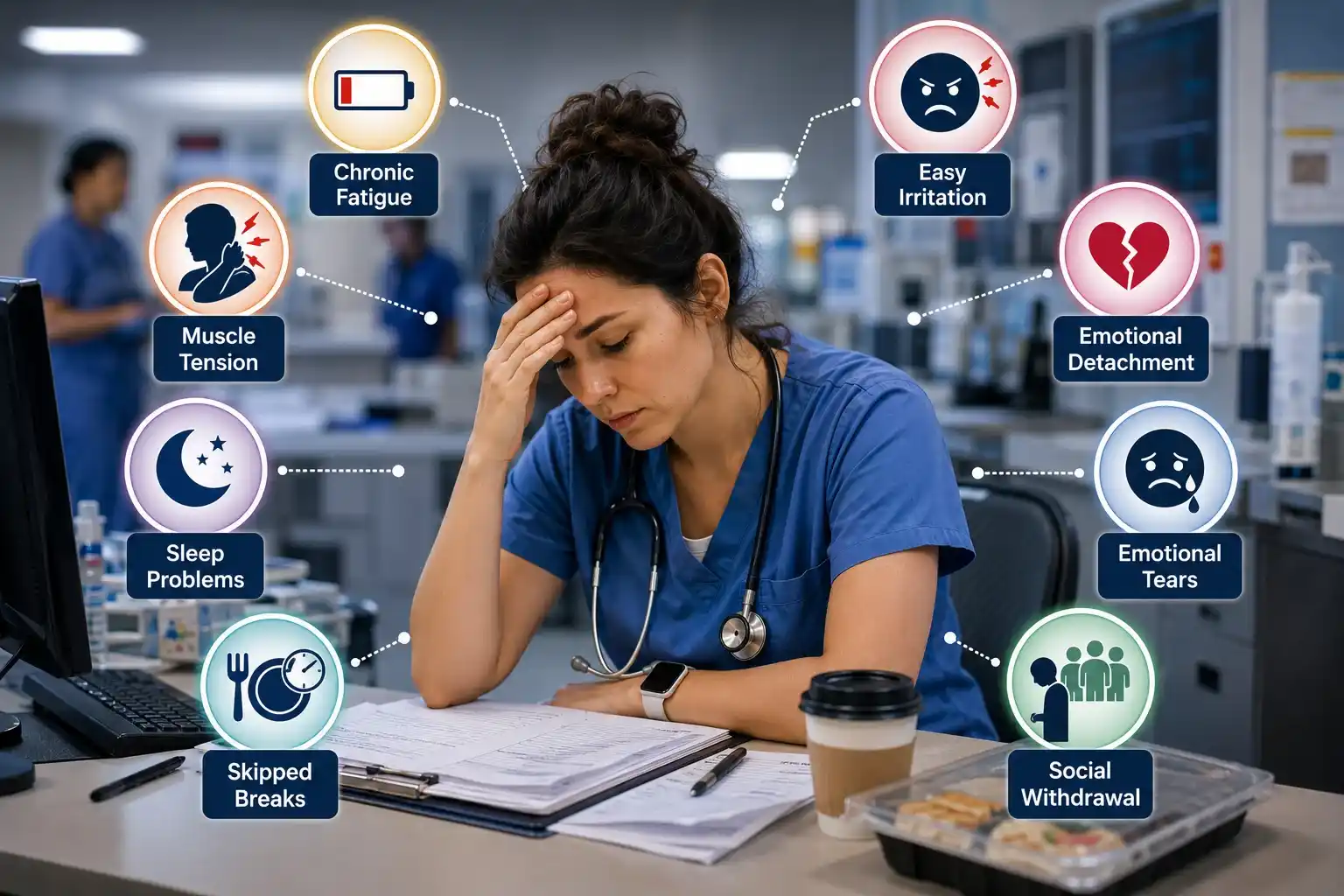
Signs of stress in nurses often go unnoticed because nurses are trained to prioritize other people’s symptoms, not their own. Here are the signals your body and mind send before full nurse burnout sets in.
Physical signs:
- Constant fatigue even after sleeping.
- Frequent headaches or muscle tension, especially in the neck and shoulders.
- Digestive problems: nausea, stomach upset, or appetite changes.
- Getting sick more often than usual.
- Trouble falling or staying asleep.
Emotional and mental signs:
- Getting frustrated more easily than usual.
- Feeling emotionally detached from your patients.
- Dreading the start of your shift.
- Crying before, during, or after work with no clear reason.
- Feeling like nothing you do makes a difference.
If you have ever found yourself crying after a difficult shift, you are not alone. Learn why these emotional moments happen and what they can tell you about stress and burnout.
Behavioral signs:
- Skipping meals or breaks.
- Increased use of alcohol, food, or other coping mechanisms after work.
- Pulling away from friends, family, or activities you used to enjoy.
- Struggling to make even small decisions.
Nurse burnout symptoms and signs of stress in nurses rarely appear all at once. Spotting them early can help you prevent more serious physical and emotional exhaustion. Long-term stress can increase the risk of preventable nursing mistakes.
Manage Stress Before Your Shift Starts
One of the best ways to manage stress is to start before your shift begins. Preparing your mind and body before your shift can help you stay focused during work and maintain a healthier work-life balance in nursing outside the hospital.
Calm Your Nervous System Before You Leave Home
Nervous system regulation starts before your shift begins. Rushing, skipping breakfast, and checking stressful content on your phone can trigger your stress response before you even walk into the hospital.
- Hydrate: Start your day with a glass of water.
- Eat protein: Have a light, protein-rich meal or snack before your shift.
- Take a quiet moment: Spend a few minutes slowing down and resetting.
- Choose a calming commute: Listen to music or a podcast that helps you relax.
Mindfulness for nurses does not require a meditation app or a yoga mat. It simply means bringing your full attention to one thing at a time. Simple routines like getting dressed, making coffee, or walking to your car can help you reset and prepare for the day when you do them mindfully.
Protect Your Sleep Like It Is a Clinical Skill
Sleep management for nurses is one of the most overlooked yet effective ways to reduce stress and prevent burnout. Sleep deprivation impairs judgment, emotional regulation, and physical recovery at every level.
Frequent schedule changes can make it tough for nurses to get consistent, restorative sleep. If you work nights or rotate between days and nights, try these adjustments:
- Use blackout curtains and a white noise machine to create consistent sleep conditions regardless of the time of day.
- Avoid bright screens for at least 30 minutes before sleep. Blue light signals your brain that it is still daytime.
- Keep your sleep environment cool (between 65 and 68 degrees Fahrenheit is optimal for most people).
- If you transition from nights to days, use a short nap rather than sleeping for a full eight hours at the wrong time. This makes the transition smoother.
- On your days off, avoid flipping your schedule too quickly. Gradual changes are easier on your circadian rhythm and overall recovery.
Plan Your Meals Before Your Shift
Nursing self-care often gets framed around bubble baths and scented candles. But in reality, eating a light meal before your shift and keeping healthy snacks nearby can help stabilize your energy and make stress easier to manage.
Quick Stress Relief Techniques for Nurses During Shift
You cannot take a long break when the unit is busy. With patients waiting and tasks piling up, stress management needs to happen in real time. Effective nurse anxiety management at work relies on simple techniques that fit naturally into your shift and provide relief within minutes.
Micro-Recovery: Small Breaks That Make a Big Difference
Micro-recovery during shifts is the practice of building brief, intentional moments of rest into your workflow rather than waiting for a break that may never come.
A 45-second pause at the nurses’ station between tasks, where you close your eyes, drop your shoulders, and take three slow breaths, can interrupt the cortisol cycle.
Research on stress physiology shows that the damage from chronic stress is not just from large stressful events. It is from never turning off the alarm. Micro-recovery is how you turn off the alarm throughout the day.
Deep Breathing Techniques for Nurses
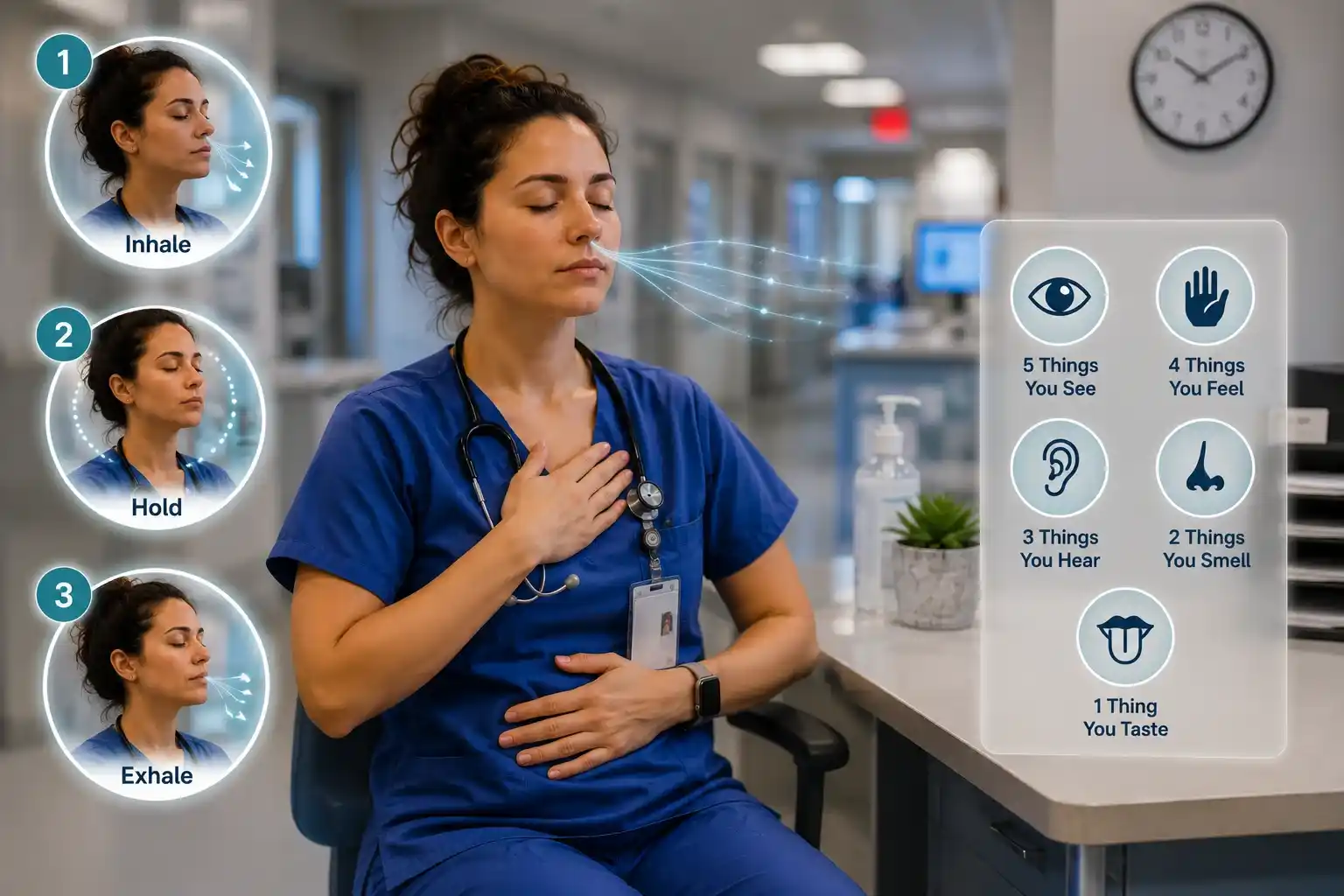
Deep breathing techniques for nurses work by activating the parasympathetic nervous system. It can reduce tension, slow your heart rate, and help you regain focus.
The most effective technique for a busy floor is the 4-7-8 breathing technique for nurses:
- Inhale through your nose for 4 counts.
- Hold your breath for 7 counts.
- Exhale slowly through your mouth for 8 counts.
- Repeat 2 to 4 times.
You can do this almost anywhere during your shift. It takes less than two minutes and can help lower your heart rate and ease stress.
Breathing exercises for nurses can also be paired with a grounding technique. After a breathing cycle, name five things you can see, four you can physically feel, three you can hear, two you can smell, and one you can taste. This technique can break the cycle of anxious thinking and help you refocus on what is happening right now.
How nurses can set emotional boundaries at work
Emotional boundaries do not mean caring less. They mean choosing where to put your emotional energy so you have enough left for the patient in front of you right now.
- Let go of what you cannot control: Staffing shortages, patient volume, hospital policies, family reactions, and unexpected emergencies.
- Focus on what you can control: Patient assessments, clear communication, task prioritization, and staying present during your shift.
Anxiety management at work gets easier when you practice this distinction regularly. This simple cognitive behavioral technique takes practice, but it can build emotional resilience and help reduce burnout.
Why Debriefing Matters After a Traumatic Event

Debrief after trauma nursing is a structured practice where team members briefly acknowledge what happened, name the emotional weight of it, and give each other permission to feel affected.
Even an informal two-minute acknowledgment between coworkers carries real protective value against secondary traumatic stress in nursing. If your unit does not have a formal debriefing process, you can initiate an informal one with a trusted colleague. “That was hard,” said out loud, is the beginning of processing.
How to Decompress After a Nursing Shift
Your brain needs a clear signal that the workday has ended. Without that signal, the mental loop of patient care continues even after you leave the building.
Emotional decompression techniques work best when they are consistent and ritualized. Consider one of the following:
- A transition playlist in the car. Choose music that signals “shift is over.” Give yourself the full drive home without checking messages.
- A short walk before you go inside. Even a 10-minute walk outside can reduce cortisol and create a clear mental break between work and home.
- A deliberate change of clothes the moment you arrive home. The act of changing out of scrubs is symbolic but effective. It marks the transition.
- A brief journaling practice. Three minutes of writing down what you carried home from your shift, and what you are choosing to leave behind, can create genuine mental closure.
Journaling for stress relief is also a tool for tracking patterns. Over time, you may notice that particular types of shifts, patients, or interactions drain you more than others. That data is useful. It helps you identify where peer support for nursing stress or professional help may be most valuable.
How to Stop Taking Work Stress Home
Unlike physical fatigue, the emotional stress of nursing does not automatically disappear after a good night’s sleep. I have seen some nurses use a simple ritual to leave the day’s emotional weight behind. One nurse I know keeps a small stone in her locker. Before leaving, she holds it for a moment, reflects on her shift, and then puts it down as a way to let go of the day’s stress.
Exercise for nurse stress is one of the most effective post-shift recovery tools, and you do not need an hour at the gym. Just 20 minutes of walking, stretching, or another activity you enjoy can lower cortisol, boost endorphins, and help your body release built-up stress.
Post-shift meditation can be simple. Spend five minutes lying down, closing your eyes, and focusing on areas where you feel tension. Then, consciously relax those muscles.
This progressive muscle relaxation practice, where you tense and then release muscle groups in sequence, is particularly effective for nurses because it targets the physical tension that accumulates in the shoulders, jaw, and lower back during long shifts.
Stress Management for Night Shift Nurses
Stress management for night shift nurses deserves its own section because the stressors are fundamentally different. Night nurses often face unique recovery challenges because their schedules work against the body’s natural sleep-wake cycle.
Specific strategies that help:
- Cluster your sleep consistently. Avoid switching back and forth, as frequent schedule changes can make recovery harder.
- Manage your light exposure. Wear blue-light-blocking glasses on your drive home after a night shift to tell your brain that sleep time is approaching. Use bright light exposure when you first wake before a night shift to boost alertness.
- Protect your gut. Avoid large late-night meals; heavy meals at irregular hours can make digestion and recovery more difficult.
- Find your night-shift tribe. Social support among night staff is one of the strongest protective factors against burnout. Peer support for nursing stress is especially valuable when your schedule makes it hard to connect with people outside of work.
Stress Management for New Nurses
Stress management techniques for new nurses matter most in the first year, when burnout risk is highest, and the gap between nursing school and the realities of bedside care can feel overwhelming.
The American Nurses Association reports that 69% of nurses under 25 experience some form of nurse burnout. Nearly one in five new nurses leaves the profession within the first year.
If you are a new nurse reading this, here is what I want you to know: the discomfort you feel is not evidence that you chose the wrong career. It is evidence that you are in a demanding transition.
For new nurses, managing stress starts with accepting that learning is part of the job. It continues with:
- Finding one experienced nurse on your unit who genuinely supports new nurses. One mentor changes everything.
- Using your orientation period to ask questions without shame. Ignorance in your first three months is expected. Silence is dangerous.
- Recognizing moral injury in nurses early: if you feel deeply troubled by a situation where you were asked to act against your values, that is not weakness. That is integrity. Talk to someone about it.
- Keeping a brief journaling practice to process the emotional load of your early shifts. Three bullet points before bed about what happened, what you learned, and what you want to do differently is enough.
If you work in critical care, our ICU nursing guide covers the unique stressors and recovery strategies that matter most.
Also read: What is imposter syndrome in new nurses?
Long-Term Strategies: Building Resilience in Nursing

Resilience in nursing is not about becoming immune to stress. It is about recovering from it more effectively. The strategies below are designed to work over months and years, not just on hard days.
Build a Real Self-Care Plan
Self-care for nurses does not have to be complicated to be effective. The best plans are simple, realistic, and built around the demands of 12-hour shifts and busy schedules.
Nursing self-care that actually works includes:
- Moving your body in ways that feel good, not punishing. Exercise does not have to be in the gym. Dancing in your kitchen, a 20-minute walk, or a yoga video at home all count. Exercise for nurse stress works because movement metabolizes cortisol.
- Connecting with people who are not nurses. Work-life balance in nursing depends on having a life outside of healthcare. Time with people who talk about things other than shift schedules, codes, and staffing helps you remember who you are outside of your role.
- Protect your days off as aggressively as you protect your patients. Sleep in. Do something not linked with healthcare. Say no to picking up shifts when you are already running on empty.
Mindfulness Techniques for Nurses at Work
Mindfulness techniques for nurses at work do not require a meditation cushion or 20 minutes of silence. True mindfulness means paying full attention to the present moment without judgment.
During a shift, you can practice this by:
- Washing your hands between patients with full attention on the sensation of the water and the soap.
- Taking three full breaths before you enter each patient’s room.
- Eating your lunch without your phone or computer for at least five minutes.
Meditation for nurses in a more formal sense, such as a 10-minute body scan or guided breathing session, is worth building into your pre-sleep routine. Even three sessions per week produce measurable reductions in emotional exhaustion in nursing over time.
How to Talk to Your Manager About Nursing Stress
The reality is that the most effective nurse managers want to know when their staff is struggling, because unaddressed stress leads to errors, absenteeism, and turnover that costs far more than support programs do.
Open communication helps identify ways a nurse manager can improve nurse morale by offering better support, recognizing staff, and addressing toxic workplace challenges. You can approach this conversation by focusing on patient safety and your commitment to the unit: “I want to keep performing at a high level, and I need your support to do that.”
Mental Health Resources for Nurses in the USA
Nurse stress management without therapy works for everyday stress, minor burnout recovery, and general wellbeing maintenance. It does not work for clinical depression, post-traumatic stress, secondary traumatic stress, or moral injury in nurses that has been building for years.
Signs you need professional support:
- You feel hopeless or trapped most days, not just on hard shifts.
- You are using alcohol, food, or other substances to cope regularly.
- You have thoughts of harming yourself or not wanting to be alive.
- You feel dissociated from your patients or your own emotions over an extended period.
- Your relationships outside of work are deteriorating because of your mental state.
Mental health resources for nurses in the USA include:
- 988 Suicide & Crisis Lifeline: Call or text 988 for free, confidential support available 24/7.
- Emotional PPE Project: Connects healthcare workers with volunteer licensed therapists for free mental health support.
- American Nurses Foundation Well-Being Initiative: Access free resources, including Crisis Text Line support by texting NURSE to 741741.
- Employee Assistance Programs (EAPs): Many U.S. hospitals offer confidential counseling sessions at no cost to employees.
- Nurse-Specific Therapy: Look for therapists who specialize in healthcare worker burnout and occupational stress.
Nurse-specific mental health support is more accessible than ever. Telehealth makes it easier for nurses to connect with a therapist on a schedule that fits their shifts.
Many nurses never use their Employee Assistance Program (EAP) because they worry about privacy. In most cases, EAP services are confidential and provide free access to counseling and mental health support.
Burnout Recovery for Nurses: Where to Start
A nurse burnout recovery plan takes months of intentional effort, sometimes with professional support. But it is possible, and nurses recover from even severe burnout every single day.
If you are currently in the middle of burnout, here is a starting point:
- Stop minimizing it. Say it out loud: “I am burned out.” This is not a personal failure. It is a health condition.
- Do one thing in the next 24 hours. Call your EAP. Book a therapy session. Text NURSE to 741741. Tell one person in your life what you are experiencing.
- Lower the bar for self-care. Keep self-care simple, realistic, and easy to maintain.
- Take stock of what is draining you most. Is it a specific rotation? A unit culture that lacks psychological safety in nursing workplaces? A relationship at work? Identifying the source helps you take targeted action.
- Build back slowly. Ways nurses can reduce burnout over time include gradually adding one recovery activity per week rather than overhauling everything at once. Sustainable change happens in small, consistent steps.
- Track your progress. Regular self-checks can help you catch stress before it turns into burnout. Use our Stress Level Checker to see where you stand.
You can use the 42% Rule of Burnout for Nurses to check in with yourself and spot early signs of burnout.
FAQs: Stress Management for Nurses
What is the difference between a stressful shift and a traumatic shift?
A stressful shift is exhausting, but you usually recover after some rest. A traumatic shift involves a deeply upsetting event that stays with you long after work ends. If difficult memories or emotions keep coming back, it may be more than ordinary stress.
How do I explain nursing burnout to family members who do not work in healthcare?
Tell them that nursing burnout is more than feeling tired. It is long-term physical and emotional exhaustion caused by constant workplace stress. Comparing it to running on an empty battery every day can help them understand what you are experiencing.
Does nursing get less stressful with experience?
Experience often makes nursing feel more manageable because confidence and clinical skills improve over time. However, even experienced nurses can struggle with burnout and workplace stress. Healthy coping habits and regular recovery are important at every stage of your career.
Final Thoughts
I started this guide with that image of you sitting in your car after a shift, too tired to move. I want to end it there too, but differently.
That moment in your car is actually an opportunity. It is a pause between who you are at work and who you are everywhere else. Used well, it becomes one of the most powerful emotional decompression techniques you have.
Take three slow breaths. Feel your hands on the wheel. Acknowledge that you showed up and you cared and you did something hard today. Then, when you are ready, drive home.
Stress management techniques for nurses work best when they stop being techniques and start being habits. That transformation happens one shift at a time, one choice at a time, over weeks and months of practice. You do not have to do all of this at once.
References
- AMN Healthcare. Survey of Registered Nurses
- Joyce University. Nursing burnout: A profession on the brink.
- American Nurses Association. What is nurse burnout? How to prevent it.
- American Nurse Journal.Nurse burnout.
- American Nurses Foundation. Well-Being Initiative and Crisis Text Line for Nurses.
- Emotional PPE Project. Free mental health support for healthcare workers.
Disclaimer: This article provides general information and should not replace advice from a qualified healthcare professional.