
How Can Nurse Managers Improve Nurse Morale? A Practical 2026 Guide That Works
Picture a nurse manager walking into her unit on a Monday morning. The whiteboard still shows Friday’s assignments. Two nurses called out. The rest of the staff pass by silently without making eye contact. The energy in the hallway is flat in a way that is hard to describe but impossible to miss.
This scene plays out in hospitals across the United States every day, and the cost is massive. According to the 2026 NSI National Health Care Retention & RN Staffing Report, replacing a single bedside RN costs hospitals an average of $60,090. This amount includes hiring, training, and staffing disruptions.
So how can nurse managers improve nurse morale in a way that actually makes a difference? Not with pizza parties or appreciation plaques, but with the kind of consistent, visible, trust-building leadership that makes nurses choose to stay.
In this guide, you will discover practical strategies with real-world implementation steps, a clear framework for identifying when nurse morale is declining, insights into what nurses actually want from their managers, and evidence-based data showing how morale directly impacts patient outcomes.
This video explains how nurse leaders can manage unprofessional behavior in nursing while improving workplace culture and staff morale.
Why Nurse Morale Is Reaching a Crisis Point in 2026
Burnout is not a new word in healthcare. But what nurses are experiencing right now goes beyond exhaustion. Researchers call it moral injury.
Moral injury refers to the emotional distress a person feels after experiencing or witnessing situations that go against their personal values or sense of right and wrong.
Burnout may improve with time off and rest, but moral injury usually requires real workplace changes and a safer, more supportive environment. The workforce data reflects just how serious this problem has become.
These stats tell us a serious story:
- The Bureau of Labor Statistics projects the United States will need 195,400 new RNs per year through 2031 to fill open positions.
- The ANA’s 2023 workforce survey found that more than 50% of nurses reported their workload had become unmanageable since the pandemic.
- One in five nurses plans to leave the profession entirely by 2027.
And here is something that often gets overlooked:
- Nurse managers are struggling too. Research from the American Organization for Nursing Leadership (AONL) shows that many nurse managers are leaving their roles at alarming rates.
- Many feel trapped between pressure from hospital leadership and the daily needs of exhausted nursing staff.
Related: Worst Nursing Mistakes
Warning Signs of Low Nurse Morale Every Nurse Manager Should Know
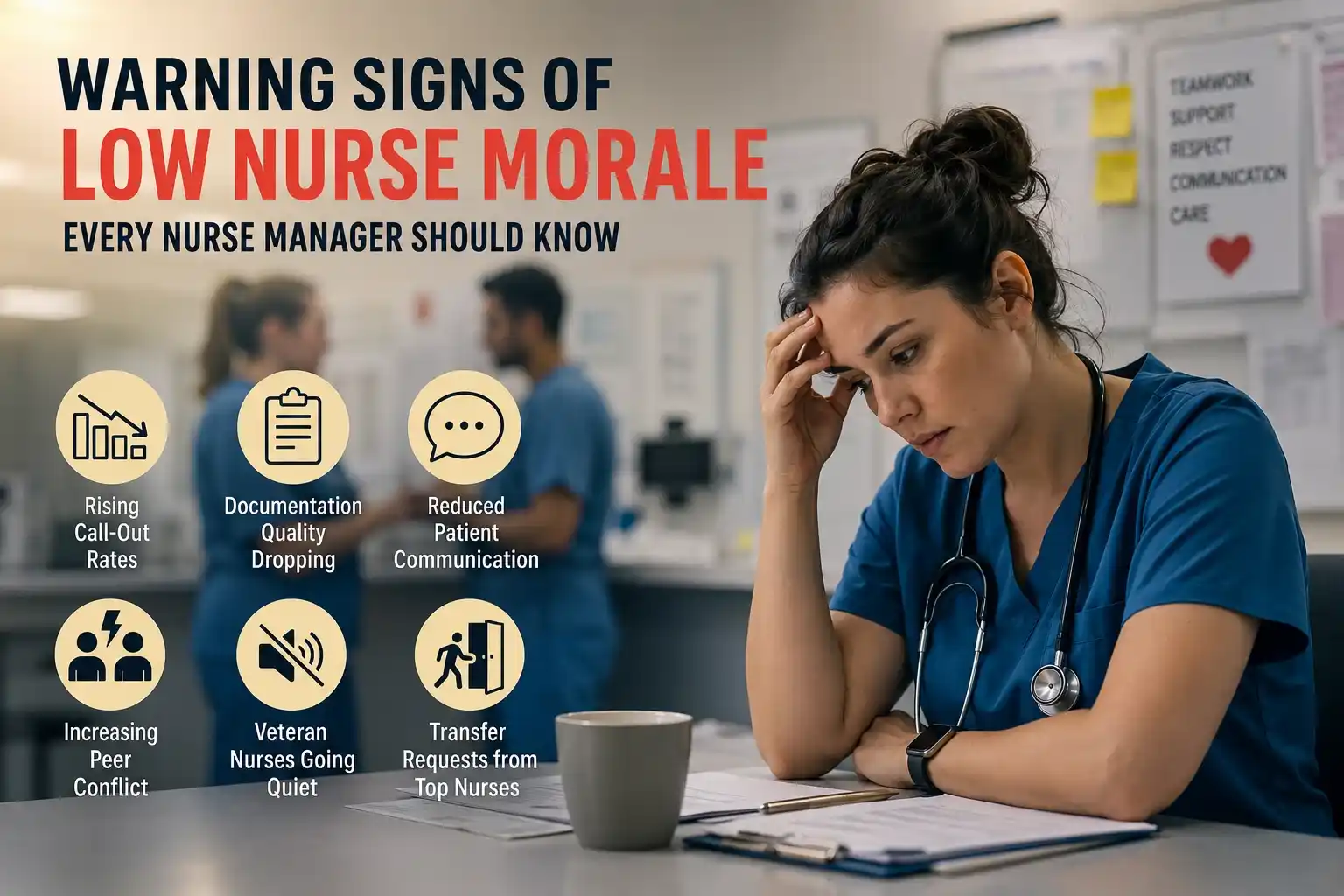
Most morale interventions come too late because managers do not know what to look for before turnover starts. Low nurse morale rarely announces itself all at once. It builds quietly through behavioral signals that are easy to dismiss individually but unmistakable in combination.
Behavioral Warning Signs
Watch for these patterns across your team, not just in one nurse:
- Rising call-out rates: One or two unexpected absences per week from nurses who used to be reliable.
- Documentation quality dropping: Assessments that are thinner, less detailed, or charted hours after care was given.
- Reduced patient communication: Nurses are completing tasks without engaging and spending less time at the bedside than the clinical situation requires.
- Increasing peer conflict: Small disagreements that turn into lasting tensions, or gossip spreading through the unit more than usual
- Veteran nurses going quiet: Experienced staff who were once vocal in meetings now sit silently or skip huddles.
- Transfer requests from your best nurses: When your most reliable people start exploring other units, that is not ambition. That is a warning.
Want to understand your stress level better? Try our free Stress Level Checker tool for a quick self-assessment.
What to Listen for in One-on-One Conversations
These phrases carry diagnostic weight. When you hear them, do not ignore them:
- “I just do my job and go home.” This is disengagement.
- “Nobody listens anyway.” This is hopelessness that has become deeply rooted.
- “I used to love this unit.” This is grief. A nurse grieving their connection to their work is not complaining. They are telling you something that matters.
- “The new nurses don’t know what they’re doing.” Often, this means experienced nurses feel unsupported and stressed by orientation loads on top of their own patient assignments.
Pro Tip: Keep a brief private log of phrases and behavior patterns you notice over several weeks. Morale problems are easier to misread in a single moment than in a trend.
Related: Toxic Hospital Culture for Nurses
What Nurses Want vs. What Managers Often Assume
When healthcare leaders discuss why nurses leave their jobs, compensation is often seen as the main reason. But when nurses are asked directly, pay usually ranks third or even lower on the list.
Gallup healthcare research shows that nurses value respect from their direct supervisors and adequate staffing levels more than salary alone. Both factors are strongly connected to job satisfaction and retention, especially when nurses are trying to deliver safe patient care.
Some nurses eventually leave traditional bedside roles to pursue alternative nursing career paths that better match their interests and career goals.
Here is a gap that exists in almost every healthcare organization, and closing it is one of the most powerful things a nurse manager can do.
| What managers often assume nurses want | What nurses consistently say they actually need |
| Higher pay and bonuses. | To feel heard by their direct supervisor. |
| Recognition awards and programs. | Specific, timely acknowledgment for individual work. |
| Team-building events and parties. | Enough staff to provide safe patient care. |
| Administrative appreciation memos. | A manager who is visible on the floor, not behind a desk. |
| Standard scheduling structures. | Flexibility, they can actually plan their lives around. |
| Annual performance reviews. | Honest, frequent, low-stakes feedback throughout the year. |
Nurses who believe their manager genuinely sees their work, advocates for them, and responds when they raise concerns stay longer, perform better, and bring more of themselves to patient care.
Related: How Nurses Can Exercise with a Busy Work Schedule
10 Effective Strategies Nurse Managers Should Use to Boost Morale
Each strategy below comes with specific implementation steps, not generic advice. Knowing what to do is less useful than knowing exactly how to start.
1. Make Recognition Specific and Timely
General appreciation accomplishes nothing. “Great job, everyone,” is background noise. “Sarah, the way you stayed with Mr. Thompson’s family for 20 minutes after his diagnosis on Friday, explaining the care plan until they felt ready, that is the kind of nursing this unit is built on.” That lands. That gets remembered.
- Open every team check-in by naming one nurse for one specific thing they did well before moving to clinical business. This takes 60 seconds and sets the tone for the entire shift.
- Create a unit whiteboard or a simple shared digital space where peer shout-outs can be posted and read between quick briefings. When nurses publicly recognize each other, a manager-driven culture of appreciation becomes a team-driven culture of belonging.
Pro Tip: Recognize in public. Correct in private. Every single time, without exception. Nurses who receive corrective feedback in front of peers do not learn faster.
2. Include Nurses in Workplace Decisions
I have found that autonomy is one of the strongest predictors of nurse job satisfaction across workforce research. When nurses feel they have no voice in the decisions shaping their daily work, they often stop feeling invested in the outcomes of those decisions.
- Before changing any scheduling policy, staffing model, supply system, or workflow, hold a 15-minute structured input session with the team. Not to seek permission. To gather intelligence from the people who actually do the work.
- After that input session, report back. Tell your team what was decided and why, including when a suggestion could not be implemented. Silence after asking for input is worse than never asking.
3. Create Flexible Scheduling That Actually Works for Nurses
Scheduling flexibility is consistently one of the biggest reasons nurses choose to stay on or leave a unit. But when scheduling options only benefit day-shift nurses while night and weekend staff face rigid timetables, trust can break down even faster.
- Offer self-scheduling within a defined framework. Give nurses a window to claim their preferred shifts before the manager fills gaps. This transfers a sense of control without creating chaos.
- Create a transparent swap process with a 24-hour approval window. When nurses can manage their own schedule changes through a clear, fair system, they feel respected as adults, not managed as bodies.
4. Stay Visible and Present on the Unit
A manager who stays absent during crises, chaotic moments, and even ordinary shifts sends a clear message: other priorities matter more than the team.
- Round on all shifts at least once per week, including nights and weekends. Night-shift nurses who never see their manager in person are not going to feel supported through emails alone.
- During every rounding visit, ask one consistent question: “What is making your job harder right now?” Write the answer down visibly, in front of the nurse who gave it to you.
May you also read: How to Survive Night Shift as a Nurse Without Losing Sleep
5. Support Professional Growth Even on a Small Budget
Nurses who see a credible career path in front of them stay. Nurses who feel stuck leave for an agency that will pay them more while they figure out what comes next. According to the American Nurses Association (ANA), professional development requires an intentional conversation and visible commitment.
- During annual reviews, identify one certification goal or learning objective for each nurse. Then create a simple, facility-supported plan that includes dedicated time, learning resources, and clear steps to help them achieve it.
- Rotate experienced nurses into charge nurse coverage, committee work, or preceptor roles as visible career progression.
6. Address Unsafe Staffing Concerns Transparently
This is the conversation that most nurse managers avoid because it feels like admitting failure. When a manager stays silent about dangerous nurse-to-patient ratios while asking nurses to work harder, nurses hear one message: leadership is not on our side.
- When staffing falls below safe levels, address it openly with your team and communicate the steps being taken.
- When nurses raise concerns, acknowledge them quickly and follow through with visible action.
7. Create Psychological Safety Within the Team
Psychological safety means nurses feel comfortable raising concerns, questioning orders, reporting errors, and speaking up about patient safety without fear of punishment or retaliation. When a unit becomes unusually quiet, it is often because staff have learned that staying silent feels safer than speaking up.
- Respond to every safety concern within 24 hours. Even when the only honest response is “I received this, and I am still looking into it,” that acknowledgment communicates that the concern was heard.
- When nurses speak up, respond to them thoughtfully, whether the concern is confirmed or not.
Working in critical care? Learn why ICU nurses face higher burnout rates.
8. Make Mental Health Support Easy to Access
An Employee Assistance Program (EAP) brochure on a break room wall is not enough. Nurses need mental health resources they can easily access, trust, and feel safe using without judgment.
- Know your facility’s EAP resources, including how nurses can access them. Mention them regularly during team briefings.
- A simple statement from a manager can reduce stigma far more than posters or brochures. When leaders are comfortable seeking help, staff are more likely to do the same.
9. Communicate Clearly and Consistently
Information vacuums in nursing units fill with anxiety, rumor, and assumption. Effective communication is not sending more emails. It is being a reliable, honest source of context that nurses can count on.
- Send a brief weekly unit update covering what changed, what is coming, and what needs nurse input. Even when nothing is urgent, the rhythm of communication matters.
- After every leadership meeting, share a one-sentence summary of anything that affects the unit within 24 hours. Nurses who hear major announcements through the hospital grapevine before their manager tells them stop trusting that manager to be honest.
Supporting managers with practical stress management strategies can reduce burnout and strengthen team morale.
10. Strengthen Team Connection Without Forced Activities
Strong workplace relationships play a major role in nurse retention. But forced team-building activities or unequal treatment between shifts can make nurses feel even more disconnected.
- Plan unit connection activities on all shifts. Nights, weekends, and 12-hour nurses who cannot attend a 5 PM event deserve the same investment of morale attention as the day team.
- Consider choosing a peer-elected morale lead from within the team. This person can organize activities based on what the staff actually wants and help communicate morale concerns directly to management.
Related: Nurses Crying After Work
How Nurse Morale Directly Impacts Patient Care
Morale conversations in nursing leadership sometimes feel like soft skills discussions. They are not. The connection between nurse morale and patient outcomes is direct, documented, and financially significant.
Gallup research shows that highly engaged nursing teams have fewer patient safety incidents. Engaged nurses are more likely to catch problems early, while disengaged nurses often focus only on completing tasks.
Hospital Consumer Assessment of Healthcare Providers and Systems (HCAHPS) data show that patient satisfaction drops when nurse morale declines. Demoralized nurses may still complete tasks, but patients can often feel the difference in care.
Related: What Is the Golden Rule of Bedside Care?
How to Handle Difficult Conversations Without Hurting Morale

Avoiding difficult conversations only allows problems to continue and can damage team morale. But when those conversations are handled respectfully and clearly, they can boost trust.
Addressing Nurses Who Have Checked Out
Do not start difficult conversations with criticism. Start with curiosity instead. A simple question like, “You seem fatigued lately. What’s going on?” often reveals the real issue, which is usually workload, stress, conflict, or emotional exhaustion rather than laziness.
May you also read: Can Burnout Cause Fatigue?
Resolving Conflict Between Nurses on the Unit
Unresolved conflict between nurses is a major reason experienced staff leave a unit. When conflicts arise, speak with each nurse privately first, focus on solutions instead of blame, and then bring both sides together around the shared goal of safe patient care.
Do not take sides. Do not minimize. Do not wait for it to resolve itself, because it will not.
Giving Corrective Feedback Without Damaging Morale
Context changes everything. “The documentation on Mr. Rivera’s chart was incomplete in two areas.” Lands very differently after a brutal 12-hour short-staffed shift than it does after a normal day. Lead with acknowledgment before you lead with correction.
“I know your shift was difficult. I want to walk through the charting on Mr. Rivera together so we can address two gaps before the next review.” It still maintains standards while showing respect for the nurse.
Related: Is It Okay to Leave Bedside Nursing?
Frequently Asked Questions
What Is Shared Governance in Nursing?
Shared governance gives nurses formal authority over clinical practice, workplace policies, and unit environment through structured councils. Nurses in shared governance environments report significantly higher job satisfaction and lower turnover intent.
What Is a Magnet Hospital in Healthcare?
A Magnet hospital is a healthcare facility recognized by the American Nurses Credentialing Center (ANCC) for excellence in nursing, strong leadership, high-quality patient care, and supportive work environments for nurses. Magnet hospitals are known for higher nurse satisfaction, better retention, and improved patient outcomes.
How Is Technology Changing Nursing Work in 2026?
Technology is helping nurses with charting, scheduling, and patient monitoring. While it can reduce workload and improve efficiency, poor training or complicated systems can also increase stress for nurses.
Where to Start This Week
I think strong teams are not built through occasional appreciation events. They grow when nurses feel safe speaking up, asking for help, and knowing their concerns will not be ignored. Over time, that kind of culture improves teamwork, retention, and patient care.
If you are asking how can nurse managers improve nurse morale, start with one small action that shows your team they matter. Nurses carry enormous emotional weight every day, and supportive leadership can make that burden feel a little lighter.
Also read: Caregiver Burnout vs Compassion Fatigue
References
- https://www.nsinursingsolutions.com/documents/library/nsi_national_health_care_retention_report.pdf
- https://www.bls.gov/ooh/healthcare/registered-nurses.htm?
- https://www.gallup.com/workplace/268211/strategies-hospital-leaders-rounding-right.aspx?utm
- https://www.aonl.org
- https://www.nursingworld.org/organizational-programs/magnet
- https://www.ahrq.gov/cahps/surveys-guidance/hospital/index.html
- https://www.nursingworld.org/practice-policy/workforce/
Disclaimer: This content is for educational purposes only and is not professional medical or workplace advice.
Interested in contributing to our website? Visit our Write for Us page to share your expertise with our readers.